Radha Rani's Appearance Day · Abhishek · Barsana Hilltop · 2026
The most emotionally sacred day in the Braj devotional calendar for Radha bhaktas. Lakhs gather at Radha Rani's hilltop temple in Barsana, at Banke Bihari in Vrindavan, and in every temple across the Braj Mandal to celebrate the appearance of the one whose name is always spoken before Krishna's — Radhe Radhe.
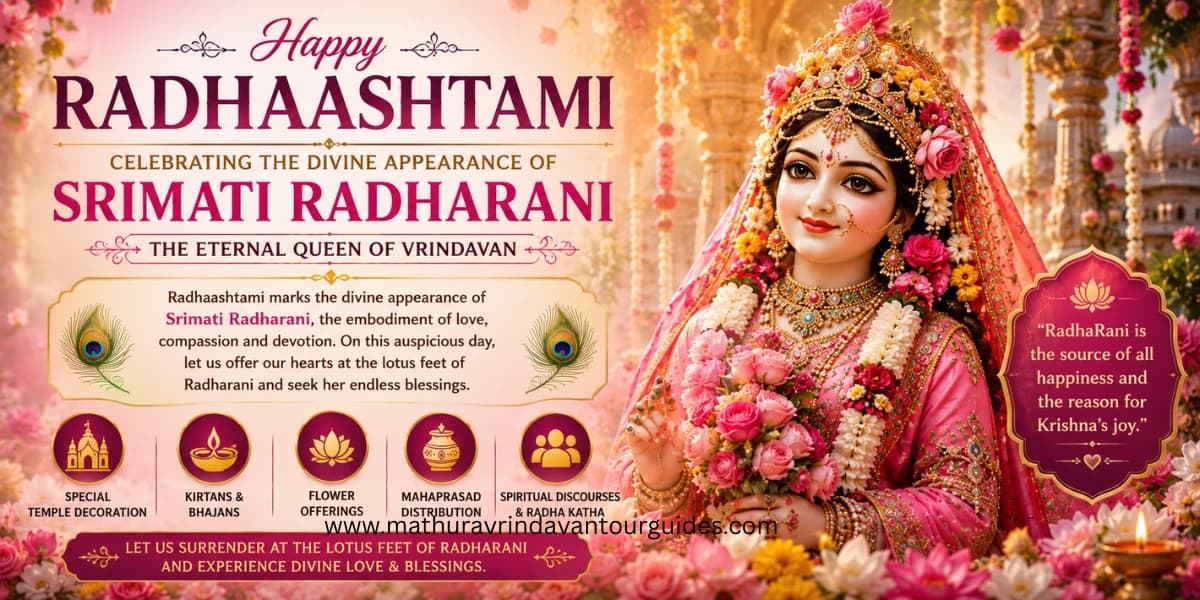
Quick Answer — Radhashtami Vrindavan & Barsana 2026
Festival Name
Radhashtami (Radha Ashtami)
2026 Date
~2 September 2026
Tithi
Ashtami, Bhadrapada Shukla Paksha
Primary Location
Barsana & Vrindavan, Uttar Pradesh
Crowd Level
Very High — lakhs of devotees
Book Hotel By
4–6 weeks in advance
Best Arrival
Evening before Radhashtami
Main Event
Abhishek at Radha Rani Temple, Barsana
Dress Code
Traditional — saree / salwar recommended
Barsana Steps
200+ steps to Ladli Ji Mandir
Entry Fee
Free at all temples
Nearest Station
Mathura Junction — 43 km from Barsana
In the devotional traditions of Braj — and especially in the Gaudiya Vaishnava, Nimbarka and Pushtimarg sampradayas — Radha is not simply Krishna's consort. She is the hladin shakti — the pleasure potency of the divine — without whom Krishna's form itself is considered incomplete. The salutation of Braj — Radhe Radhe — places her name first. The mantra Radhe Shyam places Radha before Krishna. This is deliberate and theological, not conventional.
Radha Rani is said to have appeared in Barsana — born in the home of Vrishabhanu Maharaj and his wife Kirtida. The exact spot is marked by the Radha Rani Temple (Ladli Ji Mandir) atop Brahmagiri Hill. Barsana is thus her birthplace in the same way Mathura is Krishna's — which is why Radhashtami at Barsana is considered the equivalent of Janmashtami at Mathura.
Radhashtami falls exactly 15 days after Janmashtami — as if the calendar itself acknowledges that the one who is named first must appear after. Devotees say: Janmashtami is the celebration of the Lord's birth. Radhashtami is the celebration of love itself coming into the world.
Saffron-yellow and pink are associated with Radha Rani. On Radhashtami, devotees wear these colours as an offering. The Radha Rani Temple in Barsana is decorated in yellow marigolds and pink roses — the combined fragrance is extraordinary.
The Brahmagiri Hill in Barsana is said to be the earthly manifestation of Vaikuntha — the divine abode. Standing at the top of the hill, at the feet of Radha Rani's temple, on Radhashtami dawn is described by devotees as one of the most powerful spiritual experiences available in this world.
In Braj, people greet each other with Radhe Radhe — not Jai Shri Krishna. This reflects the supremacy of Radha in local devotional culture. On Radhashtami, this greeting fills every street, every temple, every home across the Braj region.
While Janmashtami draws larger crowds in absolute numbers, Radhashtami — particularly at Barsana — is considered by many devotees to have a more intimate and emotionally deep atmosphere. The crowd at Barsana is composed almost entirely of bhaktas with deep personal devotion to Radha, creating a uniquely charged spiritual environment.
The principal abode of Shri Radha Rani sits atop Brahmagiri Hill in Barsana — her birthplace. On Radhashtami, the hilltop temple is decorated with thousands of fresh flowers, coloured lights and special ornaments. The midnight Abhishek ceremony — when the deity is bathed in panchamrit and adorned — draws lakhs of devotees. The steps leading up to the temple are lined with worshippers for hours.
Arrive by 9 AM to avoid the extreme crowd on the 200+ steps. The Abhishek ceremony happens in the late evening — be in position by 6 PM. Our VIP Darshan service for Barsana is especially recommended on this day.
The pre-dawn Mangala Aarti and the evening Abhishek ceremony
Banke Bihari Temple — where Radha and Krishna are worshipped together in Vrindavan's most beloved form — holds an extraordinary Shringar darshan on Radhashtami. The deity is decorated in special Radhashtami attire, and the curtain (parda) remains open for extended periods. The lanes around the temple fill from early morning.
Managed darshan through Gate No. 5 is absolutely essential on Radhashtami at Banke Bihari. General queue can be 3–4 hours.
Banke Bihari Radhashtami Shringar — the deity in special Radha-themed adornment
One of Vrindavan's oldest and most sacred temples — home to the self-manifested Radha Raman deity who has never left Vrindavan since appearing in 1542 AD. On Radhashtami, the Goswami priests perform elaborate rituals in the traditional Gaudiya Vaishnava style. The atmosphere is deeply intimate and devotional.
Arrive early morning. The traditional character of this temple makes it one of the most authentic Radhashtami experiences in Vrindavan.
Early morning aarti and the special Radhashtami bhog offering
ISKCON holds a grand Radhashtami programme with kirtan, cultural performances, special abishek and prasad distribution. Well-organised with fixed entry, making it the most accessible option for families and first-time visitors. The Radha Shyamasundar deity is elaborately decorated for the occasion.
Best option for organised, comfortable Radhashtami experience. Programmes run from early morning through the evening.
ISKCON Radhashtami evening programme — kirtan, abishek and prasad distribution
Seva Kunja and adjacent Nidhivan are the most intimate sacred spots associated with Radha in Vrindavan. On Radhashtami, devotees visit these groves for quiet, personal darshan. The atmosphere is contemplative and deeply moving — away from the major temple crowds.
Visit Seva Kunja and Nidhivan early morning or late afternoon for a quieter, more personal Radhashtami darshan experience.
The sacred grove atmosphere on Radhashtami morning — flowers offered at the trees
Pre-dawn
First aarti on Radhashtami — Radha Rani is awakened at her birthplace. The most sacred moment of the day at Barsana.
~6:30 AM
The deity is adorned in special Radhashtami attire — fresh flowers, gold ornaments and coloured garments.
~11:30 AM
Midday offerings and aarti. Temples briefly close after this for preparation of evening celebrations.
~7:00 PM
Evening aarti as the celebrations reach their peak. At Barsana, the hilltop temple is fully lit.
Evening
THE HIGHLIGHT — the sacred bath ceremony (panchamrit abishek) at Radha Rani Temple Barsana. Milk, honey, curd, ghee and sugar are offered to Radha Rani's deity. The most emotionally powerful moment of Radhashtami.
~10:00 PM
Final aarti of the day. Temples close after this. Many devotees spend the night near the temple in kirtan.
Evening before Radhashtami
Night Before — Preparation
Arriving the evening before Radhashtami is ideal. All of Barsana is already in festive mode — the lanes and temple steps are lit, floral decorations are being put in place, and kirtan programmes run through the night. The atmosphere the night before is often more contemplative and accessible than the main day itself. Many devotees spend this night in the temple complex singing Radha Naam.
4:00 AM – 7:00 AM
Pre-Dawn — The Holiest Hours
The Mangala Aarti at Radha Rani Temple Barsana in the pre-dawn hours of Radhashtami is considered the most sacred moment of the festival. The entire hilltop is lit with lamps, flowers are offered on every step, and the fragrance of incense fills the cool morning air. Devotees who arrived the night before are already in position. If you want to experience the true spiritual core of Radhashtami, the pre-dawn aarti is where you need to be.
7:00 AM – 12:00 PM
Morning — Barsana Pilgrimage
The 200+ steps leading to Radha Rani Temple become a steady human river of pilgrims. The climb itself is considered an act of devotion on this day — many devotees do it barefoot. At the top, the temple's main courtyard is filled with the sound of devotional songs, conch shells and bells. The Shringar darshan shows Radha Rani in her most elaborately adorned form of the year.
12:00 PM – 6:00 PM
Afternoon — Vrindavan Celebrations
After Barsana, many pilgrims travel the 50 km to Vrindavan for the afternoon and evening celebrations. Banke Bihari Temple, Radha Raman, ISKCON and Nidhivan all hold continuous programmes. The afternoon is slightly less crowded than the morning in Vrindavan — a good window for temple visits with slightly easier crowd management.
6:00 PM onwards
Evening — The Abhishek
The Abhishek ceremony at Radha Rani Temple Barsana is the emotional centrepiece of Radhashtami. The priests perform the panchamrit bath of Radha Rani's deity — milk, curd, honey, ghee and sacred water are poured over the idol while Vedic mantras fill the air. The sound of thousands of devotees chanting Radhe Radhe in unison outside the temple creates a bhakti atmosphere that is genuinely transformative. Be in position before 5:30 PM.
Delhi
~200 km to Barsana
Train to Mathura Junction, then taxi/car 43 km to Barsana — total ~3.5 hrs.
Yamuna Expressway to Mathura then Barsana road — ~3.5 hrs by car.
Depart Delhi by 5–6 AM on Radhashtami to reach Barsana by 9–10 AM. Or arrive the previous evening.
Mathura
~43 km
No direct train — taxi from Mathura Junction — 55–60 min.
Mathura–Govardhan–Barsana road — ~55 min.
Most pilgrims base in Mathura. Take a guide who knows both Barsana and Vrindavan routes.
Vrindavan
~50 km to Barsana
Auto/taxi from Vrindavan — 1.15 hrs.
Vrindavan–Mathura–Barsana — ~1 hr 15 min.
Combine: early Vrindavan temples → Barsana Abhishek evening. One of the most rewarding Radhashtami day plans.
Agra
~100 km
Train to Mathura then taxi to Barsana — ~2.5 hrs total.
Agra–Mathura–Barsana — 2 hrs by car.
Agra + Barsana is a rewarding two-day trip — Taj Mahal day one, Radhashtami day two.
With over 19 years of local expertise in Mathura and Vrindavan, we have served more than 38,000 happy devotees. Our 4.8/5 average rating reflects our commitment to providing authentic, comfortable, and memorable spiritual journeys in the sacred Braj region.
“Darshan is the essence of our yatra.”
Guides born and raised in Braj, not outsiders.
Every tour is designed around temple darshan and spiritual experience.
No hidden fees — clear, upfront pricing for all services.
Well-maintained vehicles with trusted drivers for safe travel.
Your spiritual journey is our top priority — we serve with devotion.
Always available to assist you before, during and after your tour.
We treat every yatra as a sacred seva, not just a tour package.
Guides born and raised in Braj, not outsiders.
Every tour is designed around temple darshan and spiritual experience.
No hidden fees — clear, upfront pricing for all services.
Well-maintained vehicles with trusted drivers for safe travel.
Your spiritual journey is our top priority — we serve with devotion.
Always available to assist you before, during and after your tour.
We treat every yatra as a sacred seva, not just a tour package.
भगवान श्री कृष्ण की कृपा से हर यात्रा सफल और सुखद होती है
We planned our Mathura Vrindavan trip with them and everything was handled very efficiently. Pickup, temple visits, and timing were all well managed. The journey felt smooth without any confusion.
Arjun Mehta
Mumbai
Coming from a different state, we were unsure about local arrangements. The team guided us properly and ensured we visited temples at the right time. It made the trip very peaceful.
Srinivas Reddy
Hyderabad
The tour plan was simple and comfortable. We had enough time for darshan and rest. It never felt rushed, which is important when travelling with family.
Ritu Saxena
Kanpur
The driver was experienced and knew all the routes well. We avoided traffic and reached temples at good times. The overall coordination was very good.
Debashish Ghosh
Kolkata
It was my first visit to Mathura Vrindavan and I didn't know how to cover everything. The itinerary made it easy and comfortable to visit all important places.
Vignesh Kumar
Chennai
Temple timings were planned very smartly. We reached early and avoided long queues. That made the darshan experience much better.
Simran Kaur
Amritsar
I travelled with elderly family members and the trip was planned with good balance. We never felt tired and everything was managed patiently.
Pradeep Yadav
Varanasi
The journey was organised and calm. We got enough time at each temple to experience the place properly. The overall trip felt well structured.
Anita Nair
Kochi
Hotel, travel, and temple visits were all coordinated properly. We didn't have to worry about anything and could focus on the spiritual part.
Manish Agrawal
Bhopal
Even during crowded hours, the team guided us well and managed everything smoothly. It made our visit comfortable and stress-free.
Sohini Chatterjee
Siliguri
Multiple temple visits were planned in a very organised way. The timing and travel routes were handled carefully to avoid delays.
Rakesh Naidu
Vijayawada
The experience felt genuine and well managed. It didn't feel rushed or commercial. Our Mathura Vrindavan trip was peaceful and memorable.
Pallavi Gupta
Gwalior
Radhashtami is the appearance day of Shri Radha Rani — the divine consort and eternal beloved of Lord Krishna. It is observed on the Ashtami (eighth day) of the bright fortnight of the month of Bhadrapada, typically in August or September. In the devotional tradition of Braj, Radha is considered the supreme devotee — the very embodiment of love and bhakti. Her appearance day is celebrated with as much or more devotion than even Janmashtami in many Braj traditions, particularly in Barsana (her birthplace) and throughout Vrindavan.
Radhashtami 2026 is expected to fall on approximately 2 September 2026. It falls on the Ashtami of the Shukla Paksha (bright fortnight) in the month of Bhadrapada — exactly 15 days after Janmashtami. The exact date is confirmed annually by the Panchang.
Barsana is the birthplace of Shri Radha Rani. The principal temple — Radha Rani Temple (Ladli Ji Mandir) — sits atop Brahmagiri Hill in Barsana and is considered the most sacred Radha temple in the world. On Radhashtami, the temple is the epicentre of the festival. The elaborate Abhishek ceremony performed here by the hereditary Goswami priests is the most significant religious event of Radhashtami in the entire Braj region.
In the Braj devotional tradition — particularly in the Gaudiya Vaishnava, Nimbarka and Pushtimarg sampradayas — Radha is not merely a goddess but the very essence of bhakti itself. She is considered the Shakti (divine energy) of Krishna without whom his form is incomplete. The phrase 'Radhe Shyam' or 'Radhe Radhe' — the primary salutation of Braj — places Radha's name before Krishna's, reflecting her supreme position in this tradition. Worshipping Radha, offering her name to others and serving her devotees are considered acts of the highest merit in Braj.
The Abhishek (sacred bath ceremony) is the emotional highlight of Radhashtami at Barsana. Panchamrit — a mixture of milk, curd, honey, ghee and sacred water — is ceremonially poured over the deity of Radha Rani by the hereditary Goswami priests while Vedic mantras are chanted. Flowers and special ornaments are then placed on the deity. The ceremony is performed in the evening and is accompanied by thousands of devotees outside the temple chanting Radhe Radhe.
Yes — the climb is manageable for most devotees, but requires preparation. The 200+ steps have good hand rails and are well-maintained. On Radhashtami, the steps become extremely crowded — arrive before 9 AM for a more comfortable ascent. For elderly visitors, we recommend starting the climb very early morning (6–7 AM) or using our guide service for the managed route. Palanquin (doli) service for elderly devotees is available locally and our guide can coordinate this.
All major temples in Vrindavan celebrate Radhashtami with special decorations, Shringar (adornment of deities), extended darshan hours and kirtan programmes. The temples most associated with Radha — Banke Bihari (where Radha and Krishna are worshipped together), Radha Raman, Radha Damodar, Seva Kunja and Nidhivan — hold their most elaborate ceremonies of the year on this day. ISKCON Vrindavan also holds a grand international programme.
In many Braj devotional traditions, Radhashtami is considered equally or even more important than Janmashtami — because Radha is considered the supreme deity in Braj bhakti. In Barsana specifically, Radhashtami is the single most important day of the year — more so than even Janmashtami. In Vrindavan, both days are equally celebrated, but the depth of emotion on Radhashtami — particularly at the Abhishek — can feel even more intimate than the larger Janmashtami crowd.
Traditional attire is strongly recommended and is considered a respectful offering to Radha Rani. Women: saree or salwar-kameez with dupatta. A yellow or pink coloured outfit is considered especially auspicious on Radhashtami as these are Radha's colours. Men: dhoti-kurta or kurta-pyjama. Remove footwear before entering the temple. Avoid western casual clothing — you will be in a deeply devotional environment and traditional dress is the norm.
Yes — this is the most recommended approach. Start early at Barsana for the morning Shringar darshan and the hilltop atmosphere (arrive by 8 AM). After Barsana, travel to Vrindavan for afternoon temple visits and the evening Banke Bihari Shringar darshan. With a guide and pre-arranged transport, this route covers both epicentres of Radhashtami. Barsana to Vrindavan is 50 km — about 1 hour 15 minutes.
Discover Mathura Vrindavan – the divine land of Shri Krishna with peaceful darshan, expert local guides, and comfortable travel experiences.
Rated by 38,000+ devotees
Explore More Mathura Vrindavan Festivals
Radhashtami is one of the most sacred festivals in Braj Bhoomi, celebrated in Radha Dham Vrindavan and Barsana with divine joy and enthusiasm. Radhashtami is the day of appearance of Shri Radha Rani and thousands of devotees, saints, pilgrims and Krishna bhakts from all over India and abroad visit and celebrate this day. Full of devotional songs, flower decoration, temple rituals, bhajans and spiritual get-together, the entire region of Braj comes alive.
The sacred festival attracts the attention of Barsana, birthplace of Radha Rani. There are famous stairs that lead devotees to Radha Rani Temple where they can take part in darshan, abhishek, and devotional activities. Vrindavan temples also conduct special aartis, Jhankis, kirtans and cultural programmes during the festival.
Mathura Vrindavan Tour Guides provide the complete spiritual experience of Radhashtami to pilgrims and tourists through local travelling assistance, temple tours, darshan guidance and also experiencing the Braj festival.
According to the Hindu calendar, Radha Ashtami is celebrated on the eighth day of Shukla Paksha in the month of Bhadrapada. It is celebrated a few days after Krishna Janmashtami, and is regarded as one of the holiest days for devotees of Radha Krishna.
In Barsana and Vrindavan, special activities are started in the temples from an early morning including Mangla Aarti, Abhishek of Radha Rani, offering of flowers, and devotional singing. Devotees engage in various devotional activities such as bhajans, kirtans, temple parikrama, and spiritual discourses focused on Radha Krishna's life and divine love throughout the day.
The most prominent rituals are Panchamrit Abhishek, Radha Naam Sankirtan and grand Maha Aarti ceremonies. During the hours of the main celebration, thousands of devotees gather for darshan, making Radhashtami one of the busiest and most spiritually uplifting festivals in Braj.
The centre of Radhashtami is Radha Rani Temple in Barsana and a huge crowd visits the temple during the festival. The temple is beautifully adorned with flowers, colourful lights and traditional decoration of Braj to celebrate the birth anniversary of Shri Radha Rani.
The devotees climb up to the temple in the early morning chanting “Radhe Radhe” on the sacred stairs. Special abhishek is performed by the priests using milk, curd, honey and holy water and devotional songs create spiritual energy in the atmosphere.
Barsana is home to bhajan sandhya, kirtans, Rasleela stages and cultural activities of Radha Krishna throughout the day. The whole town is in a divine mood and with divine spirit during this grand Janmotsav celebration, devotees can feel the divine spirit in the town where Radha Rani was born.
Radhashtami is celebrated with special events and devotional activities in many temples in Vrindavan and Barsana. The most important destination is still Radha Rani Temple in Barsana which is believed to be the birthplace of Shri Radha Rani.
Banke Bihari Temple, ISKCON Temple, Prem Mandir, Radha Raman Temple and Radha Vallabh Temple of Vrindavan decorate the festival with flowers and perform Jhankis, bhajans and special darshan. Prem Mandir looks beautiful at the time of evening lighting and devotional programmes.
During Radhashtami, devotees also visit Nandgaon, Gahvar Van, Kusum Sarovar and other spiritual places around them. Each temple in Braj has its own set of traditions and rituals, creating a memorable spiritual experience for pilgrims during the auspicious festival.
Among the major events of the festival is the darshan and abhishek on the day of Radhashtami. The Panchamrit Abhishek is organised in temples with milk, honey, curd, ghee and holy water and Vedic mantras and Radha Krishna bhajans are chanted.
Special aartis are performed during the day — Mangla Aarti, Rajbhog Aarti, Sandhya Aarti and Maha Aarti. There are long lines of devotees who wait to receive blessings and to see the divinely organised celebrations within the temples.
The atmosphere of Radhashtami is extremely peaceful where there are flower showers, devotional music and spiritual chanting. People are urged to come early to take darshan as most of the temples are very busy during the day.
During Radhashtami, Barsana attracts thousands of pilgrims and tourists, and it is crucial for them to plan their travel accordingly. Barsana is very well connected from Mathura, Vrindavan, Govardhan and Delhi; lots of visitors prefer to hire local taxis for the convenience.
Visitors should make their way early in the morning to avoid crowd and congestion around the temple sites. It is advisable to wear comfortable shoes, as the way to Radha Rani Temple involves climbing steps and walking through narrow lanes.
Visitors should bring water bottles, light bags and any medicines they may need during the festival. Hotels in Barsana fill up quickly during Radhashtami celebrations so advance booking is strongly recommended.
ISKCON Vrindavan celebrates the festival of Radhashtami with glorious spiritual programs and foreign nationals. People from all over the world visit the temple for special kirtans, lectures, aartis and devotional functions dedicated to Shri Radha Rani.
Typically, the festival program features Mangla Aarti, Guru Puja, Bhagavatam discourse, Radha Abhishek, devotional singing, evening aarti and the distribution of prasadam. The temple is beautifully adorned with flowers and artwork depicting Krishna.
A big highlight in ISKCON Vrindavan is the uninterrupted chanting of Hare Krishna Mahamantra, providing a serene spiritual ambience. During the festival celebrations, cultural decorations and devotional dances are also performed.
The Radha Rani Janmotsav celebration in Barsana provides lots of devotional happiness, spiritual music and traditional Braj culture. Barsana turns into a lively town filled with devotee groups singing songs of devotion, devotional processions, and Krishna Leela performances.
Rasleela dramas are enacted by local artists depicting the divine love story of Radha Krishna and temples are decorated with flowers and cultural events are conducted throughout the day. During this festival, traditional sweets and prasadam are distributed among the devotees.
The aura during Radhashtami in Barsana is very spiritual, as there is a great connection of Radha Rani and Braj Bhoomi. The pilgrims who come here during this time enjoy a genuine taste of Braj culture and the temple's traditions, which have been observed for centuries.
The ideal period to visit Vrindavan and Barsana during Radhashtami is 1–2 days prior to the festival. This will enable visitors to avoid last-minute travel hassles and attend the early functions and rituals of the temple.
Each temple will decorate, sing the bhajans and start the spiritual activities a few days prior to Radhashtami. The evenings are particularly lovely with temples being lit up with lights and decorated with flowers.
As the festival season is busy, travelers should check the weather as well as hotel availability in advance. Early preparation enables the visitors to make their Braj Yatra experience smooth and spiritually enriching.
Radhashtami is one of the big festivals of Braj where lakhs of people visit Barsana and Vrindavan. The movement of pilgrims is very busy on the roads around the temples and often traffic restrictions are applied.
During the festival season hotels and dharamshalas fill rapidly, so it is advisable to book in advance. Many visitors opt to stay in Mathura or Vrindavan, visiting Barsana during the day.
Valuable items should not be taken on trips and tourists are advised to adhere to directions of the local administration when visiting temples. The services of local guides, who are knowledgeable about festival rituals, darshan timings, and local travel routes, can also be helpful.
There are many important spiritual places near Barsana that can be explored during the festival of Radha Ashtami. One of the most visited destinations nearby is Nandgaon — Lord Krishna's village.
The devotees also visit Prem Sarovar, Gahvar Van, Kusum Sarovar, Govardhan and Radha Kund during their Braj Yatra. These places of worship are of great importance in terms of Radha Krishna Leelas and provide a tranquil and spiritual ambience.
One can also enjoy the complete devotional ambience of Braj Bhoomi by combining Radhashtami with Govardhan Parikrama and Vrindavan temple tours.
Radhashtami is a significant day in the Hindu faith as it marks the birth of Shri Radha Rani, who represents divine love, devotion, and compassion. Devotees feel that worshipping Radha Rani makes them more eligible to receive the blessings of Krishna.
The festival is the true expression of pure bhakti and the everlasting bond of the relationship of Radha and Krishna. Saints and spiritual teachers say that Radha Rani is the personification of unconditional love and divine power.
In Braj Bhoomi, Radhashtami is not simply a festival but an emotional spiritual experience that brings devotees to Krishna consciousness and Braj culture.
Thousands of devotees participate in the beautiful celebrations of Radhashtami organised by Prem Mandir and Banke Bihari Temple. The premises of Prem Mandir are beautifully lit up with flowers and music fountain displays during the evening hours.
Banke Bihari Temple provides a more traditional devotional experience of Braj, where devotees participate in regular devotional sessions, special darshan, and spiritual celebrations in honor of Radha Krishna. The temple is still very crowded on the day of the festival.
Both temples are visited by huge numbers of people during the Radhashtami festival and visitors should arrive early, keeping extra time to manage queuing.
For many devotees, the convenience of a Radhashtami tour package ensures a seamless and efficient spiritual journey through Mathura, Vrindavan, and Barsana. These packages typically consist of transport, accommodation, temple visits, and darshan assistance.
At Mathura Vrindavan Tour Guides we offer custom designed tour packages for Braj festival tours, which include Barsana, Vrindavan, Govardhan, Nandgaon and major Radha Krishna temples.
With careful planning and local support, visitors can make the most of the temple season and enjoy guided tours, exploring the area, experiencing the spiritual aspects of the festival, and traveling with ease.
Visitors are advised to make arrangements to avoid the large number of pilgrims, traffic and long walks around temple areas before visiting Barsana during Radhashtami. Loose-fitting garments and comfortable shoes are strongly recommended when visiting temples and doing parikrama.
Some temple grounds have security measures in place, and carrying large bags or items is not advisable. Due to the high number of people, mobile networks may also slow down at peak festival times.
People should visit the temple as early in the morning as possible to have darshan and be prepared for waiting in queues. Planning and being guided by the Mathura Vrindavan Tour Guides, pilgrims can enjoy a peaceful and spiritual Radhashtami experience in Braj Bhoomi.