Divine Swing Festival · Flower Jhulas · Monsoon Vrindavan · 2026
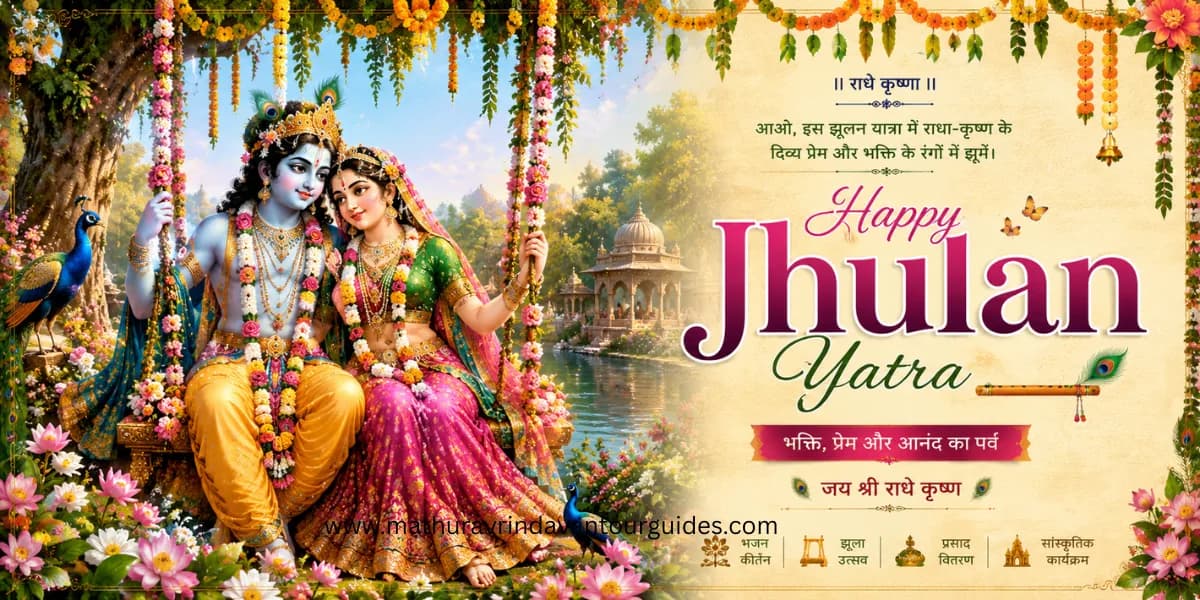
For seven days in the monsoon month of Shravana, every temple in Vrindavan installs flower-adorned swings for Radha and Krishna. Devotees sing Jhulan bhajans as the deities sway gently on swings of marigold and rose — re-enacting the divine play in Vrindavan's sacred groves.
Quick Answer — Jhulan Yatra Vrindavan 2026
Festival Period
~7 days
2026 Dates
~7–14 August 2026 (Shravana Purnima)
Season
Monsoon — Shravana month
Primary Location
Vrindavan temples (Banke Bihari, Radha Raman)
Crowd Level
High — especially evenings
Swing Decoration
Elaborate flower swings for deities
Best Time
Evening swing ceremonies at temples
Nearest Station
Mathura Junction — 12 km from Vrindavan
Dress Code
Traditional — saree / kurta recommended
Photography
Allowed in outer areas — not inside sanctum
Entry Fee
Free at all temples
Book Hotel By
2–3 weeks in advance
Jhulan Yatra celebrates the divine play of Radha and Krishna on elaborately decorated swings in the forests and groves of Vrindavan during the monsoon month of Shravana. The Bhagavat Purana and the Gita Govinda describe Krishna and Radha swinging together among the trees, garlanded with flowers, while the sakhi companions sing — and this scene is the origin of the festival.
The monsoon setting is deliberate and deeply aesthetic. Shravana is the month when the Braj landscape is at its most lush and green — the rivers are full, the air is fragrant with earth and blossoms, and the peacocks dance in the kadamba forests. Jhulan Yatra places the divine swing play precisely in this season — so that the entire natural world becomes the backdrop for the festival.
In Vrindavan, all the major temples install flower swings (jhulas) for their deities. Devotees sing Jhulan bhajans — songs describing the beauty of Radha and Krishna swinging together, the fragrance of flowers, the sound of the wind in the kadamba trees — creating a festival that is as much about poetry and sensory devotion as it is about ritual.
The jhula (swing) is decorated entirely with fresh seasonal monsoon flowers — marigold, rose, jasmine, mogra and champa. The art of creating the Jhulan jhula is a traditional craft maintained by temple priests and local artisans. The fragrance of these flower swings, combined with the humidity of the monsoon air, creates an extraordinary sensory environment.
Jhulan Yatra has its own repertoire of devotional songs — Jhulan bhajans — describing the divine swing play of Radha and Krishna. These songs in Braj Bhasha are among the most melodically beautiful in the Vaishnava tradition. During the festival, these bhajans are sung continuously in all Vrindavan temples.
Visiting Vrindavan in the monsoon is an experience distinct from any other season. The normally dry landscape turns lush green. The Yamuna fills with rain-fed waters. The fragrance of wet earth and flowers fills the temple lanes. Jhulan Yatra in monsoon Vrindavan is one of the most complete devotional and sensory experiences available in Braj.
The seven days of Jhulan Yatra correspond to the seven days of the week — one for each major form of the divine play. Each day, the temple jhulas are freshly decorated with new flowers, and each evening's ceremony has its own devotional character.
Banke Bihari Temple holds the most elaborate and famous Jhulan Yatra celebration in Vrindavan. The temple's famous swing (jhula) is decorated with fresh flowers — marigold, rose, jasmine — creating a spectacular floral canopy. Priests gently swing the deity of Banke Bihari on this flower-adorned jhula while devotees sing Jhulan bhajans. The sight of the divine Banke Bihari rocking on a flower-bedecked swing, surrounded by music and the fragrance of monsoon blossoms, is one of Vrindavan's most beautiful spectacles.
Arrive by 5 PM for the evening swing ceremony — queues form from 4:30 PM. The managed darshan through Gate No. 5 is strongly recommended for Jhulan Yatra.
The flower swing of Banke Bihari — the most photographed image of Jhulan Yatra in Vrindavan
Radha Raman Mandir celebrates Jhulan Yatra in the deeply traditional Gaudiya Vaishnava style of its hereditary Goswami priests. The self-manifested deity of Radha Raman — who has never left Vrindavan since 1542 AD — is placed on an elaborately decorated swing surrounded by seasonal flowers. The intimacy and authenticity of this celebration, conducted entirely in traditional Sanskrit mantras and Braj bhajans, is deeply moving.
Arrive early morning for a quieter, more intimate Jhulan darshan. The atmosphere at Radha Raman is more contemplative than the larger temples — ideal for those seeking a traditional experience.
The early morning Jhulan ceremony before the crowds — one of Vrindavan's most intimate devotional experiences
ISKCON holds an international Jhulan Yatra programme with kirtan, Jhulan darshan, cultural performances and elaborate flower decorations. The temple's well-organised entry and spacious grounds make it the most accessible Jhulan Yatra experience for first-time visitors and international guests. The Radha Shyamasundar deities are placed on beautifully decorated swings.
Best for families and international visitors — organised, spacious and accessible. Evening kirtan programmes during Jhulan Yatra are exceptional.
ISKCON evening Jhulan Yatra kirtan — the entire temple community participates in singing swing songs
Shahji Temple — known for its extraordinary carved columns and intimate atmosphere — holds Jhulan Yatra with particularly elaborate decorations. The temple's unique architecture provides a stunning backdrop for the flower swing celebrations.
Less crowded than Banke Bihari — a good option to experience Jhulan Yatra with more space and time for photography.
The decorated swing against the backdrop of Shahji Temple's exquisite carved marble columns
Radha Damodar Mandir — one of Vrindavan's most historically significant temples, associated with the six Goswamis — celebrates Jhulan Yatra with quiet, intimate traditional rituals. The samadhi (tomb) of Srila Rupa Goswami is in this temple's courtyard, making it a place of deep spiritual significance.
Visit Radha Damodar for a peaceful, uncrowded Jhulan Yatra experience — ideal for early morning and combining with the Samadhi darshan.
The Jhulan ceremony in the ancient courtyard near Rupa Goswami's samadhi — quietly extraordinary
Day 1 (~7 Aug)
Temples begin Jhulan Yatra. Flower swings are installed and decorated. First Jhulan darshan of the festival season.
Morning
Morning swing ceremony at all Vrindavan temples. Less crowded than evenings — good for a quieter darshan.
Afternoon
Temple priests refresh flower decorations on swings with fresh flowers for the evening ceremony.
~6–8 PM
THE HIGHLIGHT — the main Jhulan ceremony when deities are gently swung while devotees sing Jhulan bhajans and the fragrance of flowers fills the air.
Full Moon (~14 Aug)
MAIN EVENT — The final and most significant day of Jhulan Yatra, falling on Shravana Purnima. The most elaborate celebration with the largest crowds. The full moon over Vrindavan on this night is considered sacred.
Days 1–3
Temple Preparation Days
The first days of Jhulan Yatra are spent preparing the swings with fresh flowers — marigold, rose, jasmine, champa and seasonal monsoon blossoms. The fragrance of flowers in the humid monsoon air creates an intoxicating atmosphere across all of Vrindavan. Temples begin decorated programmes and special Jhulan bhajans.
Every evening ~6–8 PM
Evening Swing Ceremonies
The heart of Jhulan Yatra is the evening swing ceremony — when the deity is gently placed on the decorated flower swing and devotees take turns gently pushing it while singing Jhulan bhajans (swing songs). The sound of these bhajans — 'Jhulat Radhe Shyam' and similar compositions — filling the temple courtyard at dusk, set against the backdrop of monsoon rains and flower decorations, creates one of Vrindavan's most memorable experiences.
All day
Flower Offerings
During Jhulan Yatra, devotees bring elaborate flower offerings to temples. The markets around the temples overflow with seasonal monsoon flowers. The practice of offering flowers to the swinging deity is considered particularly meritorious during this festival.
Final day (~14 Aug)
Jhulan Purnima — The Grand Finale
Jhulan Purnima (Shravana Purnima) is the most celebrated day of the festival. All temples hold their most elaborate ceremonies. The full moon rising over Vrindavan's temple skyline, the flower-bedecked swings, the sound of thousands of devotees singing Jhulan bhajans — this is Vrindavan at its most beautiful. Crowds are highest on this day.
Delhi
~175 km
Train to Mathura Junction then taxi to Vrindavan — 12 km from station. Total ~3 hrs.
Yamuna Expressway to Mathura then Vrindavan — ~3 hrs by car.
Start early morning to arrive for the afternoon temple preparations and evening Jhulan ceremony.
Mathura
~12 km
Auto-rickshaw or taxi from Mathura station — 20–25 min.
Mathura–Vrindavan road — 20–25 min.
Mathura is the ideal base for Jhulan Yatra — easy day and evening trips to Vrindavan throughout the festival.
Agra
~75 km
Train to Mathura Junction, then taxi to Vrindavan — ~2 hrs total.
Agra–Mathura–Vrindavan — ~1.5 hrs by car.
Agra to Vrindavan day trip is very manageable — leave by 2 PM to reach for evening ceremony at 6 PM.
Jaipur
~280 km
Train to Mathura Junction, then taxi — total ~4.5 hrs.
Jaipur–Agra–Mathura–Vrindavan — ~5 hrs by car.
Consider 2 nights in Vrindavan to cover multiple days of Jhulan Yatra across different temples.
With over 19 years of local expertise in Mathura and Vrindavan, we have served more than 38,000 happy devotees. Our 4.8/5 average rating reflects our commitment to providing authentic, comfortable, and memorable spiritual journeys in the sacred Braj region.
“Darshan is the essence of our yatra.”
Guides born and raised in Braj, not outsiders.
Every tour is designed around temple darshan and spiritual experience.
No hidden fees — clear, upfront pricing for all services.
Well-maintained vehicles with trusted drivers for safe travel.
Your spiritual journey is our top priority — we serve with devotion.
Always available to assist you before, during and after your tour.
We treat every yatra as a sacred seva, not just a tour package.
Guides born and raised in Braj, not outsiders.
Every tour is designed around temple darshan and spiritual experience.
No hidden fees — clear, upfront pricing for all services.
Well-maintained vehicles with trusted drivers for safe travel.
Your spiritual journey is our top priority — we serve with devotion.
Always available to assist you before, during and after your tour.
We treat every yatra as a sacred seva, not just a tour package.
भगवान श्री कृष्ण की कृपा से हर यात्रा सफल और सुखद होती है
We planned our Mathura Vrindavan trip with them and everything was handled very efficiently. Pickup, temple visits, and timing were all well managed. The journey felt smooth without any confusion.
Arjun Mehta
Mumbai
Coming from a different state, we were unsure about local arrangements. The team guided us properly and ensured we visited temples at the right time. It made the trip very peaceful.
Srinivas Reddy
Hyderabad
The tour plan was simple and comfortable. We had enough time for darshan and rest. It never felt rushed, which is important when travelling with family.
Ritu Saxena
Kanpur
The driver was experienced and knew all the routes well. We avoided traffic and reached temples at good times. The overall coordination was very good.
Debashish Ghosh
Kolkata
It was my first visit to Mathura Vrindavan and I didn't know how to cover everything. The itinerary made it easy and comfortable to visit all important places.
Vignesh Kumar
Chennai
Temple timings were planned very smartly. We reached early and avoided long queues. That made the darshan experience much better.
Simran Kaur
Amritsar
I travelled with elderly family members and the trip was planned with good balance. We never felt tired and everything was managed patiently.
Pradeep Yadav
Varanasi
The journey was organised and calm. We got enough time at each temple to experience the place properly. The overall trip felt well structured.
Anita Nair
Kochi
Hotel, travel, and temple visits were all coordinated properly. We didn't have to worry about anything and could focus on the spiritual part.
Manish Agrawal
Bhopal
Even during crowded hours, the team guided us well and managed everything smoothly. It made our visit comfortable and stress-free.
Sohini Chatterjee
Siliguri
Multiple temple visits were planned in a very organised way. The timing and travel routes were handled carefully to avoid delays.
Rakesh Naidu
Vijayawada
The experience felt genuine and well managed. It didn't feel rushed or commercial. Our Mathura Vrindavan trip was peaceful and memorable.
Pallavi Gupta
Gwalior
Jhulan Yatra (also called Jhulanotsav or Jhulan Utsav) is a sacred festival celebrated in Vrindavan during the month of Shravana (July–August). It commemorates the divine play of Radha and Krishna on decorated flower swings (jhulas) in the forests of Vrindavan. During the festival, deities at Vrindavan temples are placed on elaborately decorated swings adorned with fresh seasonal flowers, and devotees sing Jhulan bhajans (swing songs) while gently swinging the deities.
Jhulan Yatra 2026 in Vrindavan is expected to run from approximately 7 August to 14 August 2026. It begins on Shravana Shukla Saptami (the seventh day of the bright fortnight of Shravana) and concludes on Shravana Purnima (the full moon day). The final day — Jhulan Purnima — is the most celebrated day with the largest crowds.
Banke Bihari Temple holds the most elaborate and famous Jhulan Yatra celebration in Vrindavan. The flower swing of Banke Bihari is the most visually spectacular and draws the largest crowds. For a more traditional and intimate experience, Radha Raman Mandir is exceptional. For families and international visitors, ISKCON Vrindavan offers the most organised Jhulan Yatra programme.
During Jhulan Yatra, temple priests install elaborately decorated flower swings in the temple precincts and place the deity on them. The swing is adorned with garlands of marigold, rose, jasmine and other seasonal monsoon flowers. During the daily Jhulan ceremony (primarily in the evenings), the deity is gently swung while devotees sing traditional Jhulan bhajans. Special flower offerings, bhajans, aartis and cultural programmes accompany the festival throughout the week.
Jhulan Yatra traditionally lasts for 7 days — from Shravana Shukla Saptami to Shravana Purnima. In Vrindavan, celebrations begin a few days earlier at some temples. If visiting, even 2–3 days during this period will allow you to experience the evening swing ceremony at multiple temples.
Yes — the monsoon setting is actually part of the Jhulan Yatra experience. Vrindavan in the monsoon is lush green and beautiful, and the fragrance of seasonal flowers and the rain-washed atmosphere add to the unique sensory experience of the festival. Carry a compact umbrella or light rain jacket. Accommodation in Vrindavan during August is generally not at peak-season prices, making it one of the best-value times to visit.
The nearest railway station to Vrindavan is Mathura Junction, approximately 12 km away. From Mathura, auto-rickshaws and taxis reach Vrindavan in 20–25 minutes. From Delhi, Mathura is about 2–2.5 hours by train on the Agra-bound trains. By road, Vrindavan is about 3 hours from Delhi via the Yamuna Expressway.
Jhulan Yatra is uniquely associated with Vrindavan in the devotional tradition. The festivals associated with Radha and Krishna's childhood and youth — their swing play (Jhulan), their Holi, their Raas Leela — are remembered in Vrindavan as living traditions, not merely historical events. The forests, groves and ghats of Vrindavan are considered the very locations where this divine play occurred. Experiencing Jhulan Yatra in Vrindavan, in the monsoon season when the entire landscape is lush and fragrant, connects the visitor to the original devotional context of the festival.
Discover Mathura Vrindavan – the divine land of Shri Krishna with peaceful darshan, expert local guides, and comfortable travel experiences.
Rated by 38,000+ devotees
Explore More Mathura Vrindavan Festivals
Among the most beautiful and spiritually uplifting festival is the sacred festival of Jhulan Yatra in Braj Bhoomi — Vrindavan Mathura. Jhulan Yatra is celebrated during the monsoon season in the month of Shravan, which is a representation of the divine swing pastime of Radha Krishna. In this festival, temples of Vrindavan and Mathura adorn special swings with flowers, lights, silver and colorful cloths and sit the idols of Radha Krishna and worship them with devotion.
During Jhulan Yatra, thousands of devotees, pilgrims and tourists visit Braj to enjoy the peaceful spiritual atmosphere, temple decorations, devotional songs, and cultural celebration. During the entire celebration period, major temples administer Jhulan Darshan, bhajans, kirtans, aartis at nightfall and flower festivals.
Mathura Vrindavan Tour Guides provides to the visitors full Jhulan Yatra tour service with temple tour, locality tour, darshan, tourist assistance and Braj festival sightseeing tour.
In 2026, in Shravan month, Jhulan Yatra Festival will be celebrated grandly in the temples of Vrindavan. The highlight of the festival is the Jhulan Darshan which means swings adorned in temples where Radha Krishna idols are placed.
All the swings are decorated with flowers, peacock feathers, silver ornaments, lights and coloured fabrics to give the divine appearance. The special swing darshan and devotional singing and temple rituals are also performed, with large number of devotees attending to see the same.
Normally, the festival lasts for several days and each evening special aartis and bhajans are organised in the temples along with the flower decorations. Jhulan Yatra conveys an aura of tranquility and devotion, a true reflection of the beauty of Braj culture and Krishna bhakti tradition.
Jhulan Yatra is enthusiastically celebrated in the temples of Mathura and Vrindavan. During darshan, the priests decorate beautifully the swings and place Radha Krishna idols on it as devotionaries sing bhajans and offer flowers.
During the festival, temples conduct Mangla Aarti, Jhulan Darshan, devotional kirtans, offering of flowers and evening spiritual programs. During the time of celebration, the entire atmosphere inside the temple is colourful, and the atmosphere is spiritually vibrant.
Many temples also hold Rasleela, Krishna Bhajans and cultural activities pertaining to Radha Krishna Leelas. The monsoon season weather of Braj makes the Jhulan Yatra celebration even more beautiful.
Jhulan Yatra is celebrated with elaborate swing decorations and devotional activities at many of Vrindavan and Mathura's renowned temples. Among the most popular places during the festival is Banke Bihari Temple which features a colourful Jhulan Darshan and flower decoration.
Important temples include ISKCON Vrindavan, Prem Mandir, Radha Raman Temple, Shahji Temple, Radha Vallabh Temple, and Dwarkadhish Temple. During Jhulan Yatra the traditions and decorative styles are different in each temple.
During this festival, visitors can enjoy beautiful swings, devotional music, flower showers and peaceful spiritual surroundings in these temples.
During Jhulan Yatra, Banke Bihari Temple celebrates the festival with great fervour and draws thousands of devotees to the festival grounds. The temple makes beautiful swings for Lord Banke Bihari Ji and special darshan is organised for the visitors.
Every day the temple is filled with devotional songs, bhajans, offering of flowers, and Krishna chanting. Devotees come in great numbers especially in the evenings when they come to see the beautifully decorated Jhulan Darshan.
Temple timings and crowd management arrangements are made during Jhulan Yatra. People are requested to come to the temple earlier for darshan to avoid the crowd inside the temple.
ISKCON Vrindavan organizes the Jhulan Yatra with various devotional functions, kirtan and lovely decoration of the swing. The temple is a popular destination for pilgrims from all over the world who come to attend the festival.
The programme of the festival usually consists of Mangla Aarti, Guru Puja, devotional kirtans, Jhulan Darshan, Bhagavad Gita lectures, evening Aarti and distribution of prasadam. The temple is beautifully decorated with flowers during the festival and Radha Krishna themes.
The whole devotional environment of ISKCON Vrindavan is very serene due to the continuous chanting of Hare Krishna Mahamantra and due to the cultural activities.
The celebration of Jhulan Utsav in Braj is a symbol of the divine love and playfulness of Radha Krishna. The festival period sees a variety of rituals and devotional programmes being organised by the temples.
Special pujas, flower offerings, swing ceremonies and aartis are performed by the priests and devotees engage in bhajans and kirtans. Many temples also have cultural programmes like Rasleela and devotional dance programmes.
The celebration of the festival embodies the spiritual beauty of the culture of Braj and provides an opportunity to the devotees to experience the devotion of Radha Krishna in peaceful surroundings.
Mathura and Vrindavan are crowded during the festival season, so travelers should make their arrangements beforehand when they come for Jhulan Yatra. Visitors are advised to wear comfortable clothes and shoes as they enter the temple and walk through the narrow lanes.
The majority of the temples are clustered together, making sightseeing on the spot convenient by e-rickshaw and taxi, and strolling. During the monsoon season, visitors should also bring water bottles and essential medications for their journey around Braj.
Mathura Vrindavan Tour Guides during Jhulan Yatra offers local travel, sightseeing, and guided tours of the temples to the visitors.
Evenings are the most ideal time to visit Vrindavan during Jhulan Yatra as the temples are beautifully lit up with lights and decorated with flowers. Jhulan Darshan and devotional activities are mainly organized in late afternoon and evening.
In order to avoid the rush of visitors and to easily explore temples and local spiritual places, visitors are advised to arrive a few days before the main festival.
The environment of Vrindavan and Govardhan becomes more beautiful and peaceful during the monsoon season for Jhulan Yatra celebration.
During the month of Shravan, beautiful Jhulan Yatra is organised by both Prem Mandir and Radha Raman Temple. During festival evenings, visitors are enticed to visit Prem Mandir by the coloring of lights and the decoration of flowers and the musical fountain shows.
The Radha Raman Temple practises all the traditions of the devotional practices of Braj, and special Jhulan Darshan are organised for people here. The temple is filled with devotional songs and decorations of flowers, creating a serene environment.
Two temples get huge visitors during Jhulan Yatra and offer distinct spiritual experiences for pilgrims visiting Vrindavan.
Every year, thousands of devotees visit Vrindavan and Mathura during the monsoon season, during the time of Jhulan Yatra. During festival periods, hotels, dharamshalas and guest houses near important temples tend to fill up easily.
Visitors should make advance hotel bookings and reservations for local transport to beat the rush hour. The best ways to reach the temples are still the e-rickshaws and neighbourhood taxis.
The visitors should also adhere to the temple rules and refrain from bringing unnecessary valuables during the rush of darshan hours.
Jhulan Yatra is a very special festival in Krishna bhakti traditions as it depicts the swing pastime of Radha Krishna which is done in a loving and joyful manner in the monsoon season.
Devotees believe that they attain peace, blessings and emotional connection with Radha Krishna by taking part in the Jhulan Darshan and singing devotional songs.
The festival embodies the majesty of the beauty of the culture, devotion and traditional temple festivity since centuries in Vrindavan and Mathura.
Prior to coming to Vrindavan during Jhulan Yatra, it is best to be ready for rain in the monsoon season, heavy footfalls in the temples and traffic restrictions around the popular temples.
It is advisable to wear comfortable clothes, umbrella, water bottle and some basic medicines for the trip. Additionally, visitors should begin temple visits early in the day to make it easier to enjoy darshan and sightseeing.
Local guides can be engaged to educate visitors about the traditions of the temple, the rituals of the festival, and the significance of various locations for sightseeing during the celebration of Jhulan Yatra.
A lot of people prefer to book Jhulan Yatra tour packages for a hassle-free and comfortable spiritual journey in Braj Bhoomi. These packages typically cover a visit to the temples, sightseeing, hotel and transportation.
Mathura Vrindavan Tour Guides provide personalized tour packages of Jhulan Yatra in Vrindavan, Mathura, Govardhan, Barsana and spiritual places nearby.
During the festival season visitors can enjoy guided tours of the temple, local sightseeing, Jhulan Darshan and devotional experiences with proper travel support.
Vrindavan temples are also well-known for their lovely flower decorations and Jhulan Darshan during the festival days. To make divine visual experiences, fresh flowers, peacock feathers, silver ornaments and colourful fabrics are used to decorate swings.
Temples decorate grandeur and provide special evening darshan to devotees, like Banke Bihari Temple, Prem Mandir, ISKCON Temple and Radha Raman Temple.
Jhulan Yatra is one of the most peaceful and beautiful festivals in Braj Bhoomi due to the devotional music, monsoon atmosphere, flower decorations and worship of Radha Krishna.