Holiest Month in Braj · Deepdan · Parikrama · Dev Deepawali · 2026
Every evening for a full month, thousands of diyas are offered to the Yamuna at Keshi Ghat. Every morning, devotees bathe in the sacred river before dawn. Kartik Maas is not a single festival — it is an entire month of living devotion in Vrindavan.
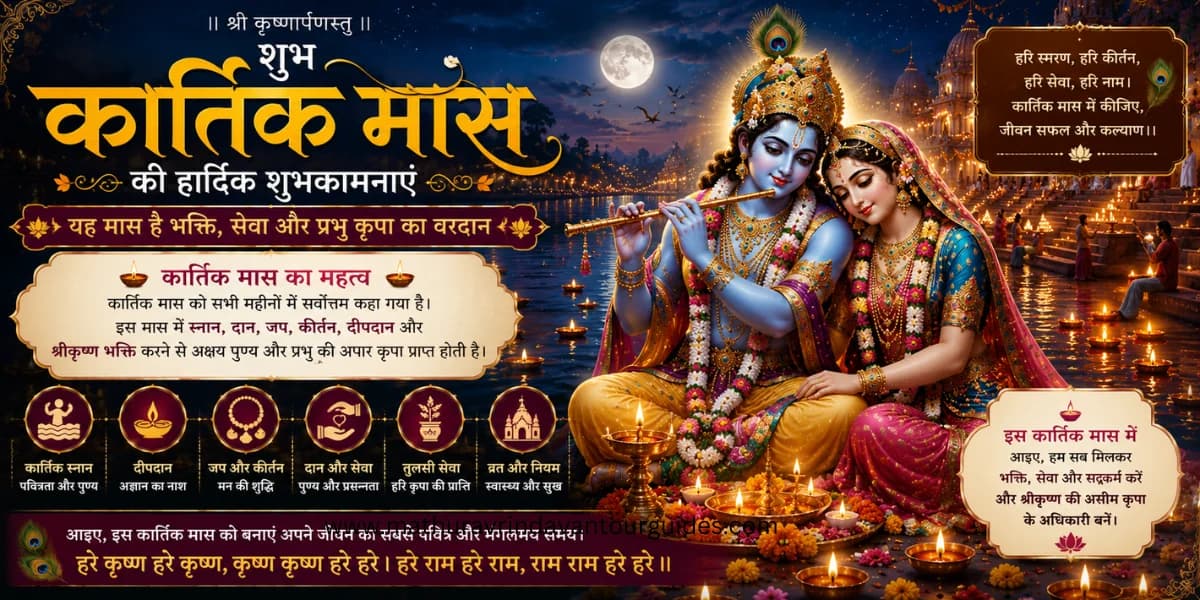
Quick Answer — Kartik Maas Vrindavan 2026
Month Duration
~30 days
2026 Dates
~3 October – 1 November 2026
Daily Deepdan
Keshi Ghat, Vrindavan — 6:30 PM
Parikrama
Every evening — Vrindavan Parikrama route
Dev Deepawali
Last day — Kartik Purnima ~1 Nov 2026
Crowd Level
Steady all month — peaks on Ekadashi & Purnima
Best For
Spiritual retreat — ideal month to stay
Tulsi Vivah
Near month end — temples celebrate
Morning Activity
Yamuna Snaan at ghats (sacred bath)
Accommodation
Book 2–3 weeks ahead
Entry Fee
Free at all temples and ghats
Nearest Station
Mathura Junction — 12 km from Vrindavan
Among the twelve months of the Hindu calendar, Kartik Maas holds a unique status in the Vaishnava tradition — it is considered the month most beloved by Lord Vishnu and Lord Krishna. The Padma Purana describes Kartik as the month when any devotional act — bathing in a sacred river, offering lamps, hearing Bhagavat Katha, performing parikrama — yields merit multiplied a thousandfold compared to other months.
In Vrindavan, Kartik is not just a festival — it is a complete spiritual season. Thousands of devotees from across India and around the world come to Vrindavan to spend the entire month performing the traditional Kartik Vrat. The daily rhythm of Yamuna Snaan at dawn, Mangala Aarti, temple darshan, Bhagavat Katha, evening Parikrama and Deepdan at Keshi Ghat creates an immersive spiritual environment unlike any other time of year.
The month culminates in Dev Deepawali (Kartik Purnima) — considered even more sacred than the regular Diwali — when the gods themselves are said to descend and light lamps on the Yamuna.
Offering a lit oil diya to the Yamuna river during Kartik is one of the most meritorious acts in the Braj tradition. The Keshi Ghat Deepdan ceremony — where thousands of diyas are released onto the Yamuna simultaneously every evening — is one of the most visually stunning daily rituals in Braj.
Kartik is also known as Damodar Maas — the month of Lord Damodar (a form of Krishna who was bound by Mother Yashoda). Every evening during Kartik, the Damodar Ashtakam — a hymn describing this scene — is sung while offering lamps to the deity. This evening ceremony at ISKCON Vrindavan is deeply moving.
Tulsi Vivah — the ceremonial wedding of the sacred Tulsi (holy basil) plant to Lord Vishnu — takes place in the latter part of Kartik month. This ceremony marks the end of Chaturmas (the four-month period when deities are said to sleep) and the resumption of marriages and auspicious activities.
Kartik Purnima (the full moon that ends Kartik month) is celebrated as Dev Deepawali — the Festival of Lights of the Gods. It is said that on this night, the gods descend to bathe in sacred rivers and celebrate with lamps. Dev Deepawali in Vrindavan is considered more sacred than Diwali itself.
Every evening throughout Kartik month, thousands of devotees gather at Keshi Ghat on the Yamuna riverbank in Vrindavan to perform Deepdan — the offering of oil lamps to the Yamuna river. The sight of thousands of tiny flames being set afloat on the dark Yamuna waters, against the backdrop of Keshi Ghat's ancient architecture and the evening aarti, is one of the most visually and spiritually profound experiences in all of Braj.
Arrive at Keshi Ghat by 6 PM. The Deepdan ceremony begins at ~6:30 PM and lasts 30–45 minutes. Bring your own diya (lamp) from the stalls near the ghat — the experience of personally offering your lamp to the Yamuna is deeply meaningful.
The moment when thousands of diyas are released simultaneously onto the Yamuna — a river of light
ISKCON Krishna Balram Mandir holds an extraordinary month-long programme for Kartik — including daily Damodar Ashtakam singing at dusk (lamp offering while singing prayers to Lord Damodar), special Bhagavat Katha, Kartik Parikrama groups and elaborate cultural programmes. The Kartik Damodar Ashtakam ceremony at ISKCON — where thousands of devotees simultaneously offer their lamps to the deities while singing the Damodar Ashtakam hymn — is one of the most moving devotional experiences available.
Attend the ISKCON Kartik Damodar ceremony every evening — time it to coincide with both ISKCON's programme and the Keshi Ghat Deepdan on the same evening.
ISKCON Damodar Ashtakam ceremony — thousands of devotees offering lamps in unison
Banke Bihari Temple holds special extended darshan hours during Kartik month. The temple is elaborately decorated throughout the month, and special Shringar (adornment of deities) is performed. On Ekadashi and Kartik Purnima days, crowds are extreme but the devotional atmosphere is correspondingly extraordinary.
Visit Banke Bihari on a weekday morning during Kartik for a more comfortable darshan. Avoid Ekadashi and Purnima if crowd management is a concern.
Banke Bihari Kartik Shringar — the elaborate decoration of the deity during this sacred month
Morning bathing (Snaan) in the Yamuna during Kartik month is considered one of the most meritorious acts in the Braj tradition. Devotees wake before dawn and bathe in the Yamuna at Keshi Ghat, Imli Tala Ghat and other sacred ghats throughout the month. The pre-dawn atmosphere at the ghats in Kartik — the sounds of bells and bhajans across the water, the sight of diyas on the river from the previous night still flickering — is deeply evocative.
Join the pre-dawn Yamuna Snaan at Keshi Ghat at 5–5:30 AM for the most authentic Kartik morning experience. This is a living daily ritual, not a tourist spectacle.
Pre-dawn Yamuna Snaan in Kartik — devotees bathing in the sacred river as the sky lightens
Prem Mandir is illuminated throughout Kartik month with special light effects depicting Krishna's leelas. The evening programme at Prem Mandir, combined with a walk to Keshi Ghat for Deepdan, forms one of the most recommended evening routes in Vrindavan during Kartik.
Prem Mandir is most spectacular from 7–9 PM when the light shows run. Combine with Keshi Ghat Deepdan at 6:30 PM for a full Kartik evening.
Prem Mandir illuminated during Kartik month — the entire marble exterior lit with devotional imagery
5:00–5:30 AM
Sacred Kartik bath in the Yamuna. Considered highly meritorious throughout the month. Pre-dawn bathing at Keshi Ghat with other devotees.
5:30–6:00 AM
First aarti of the day at all Vrindavan temples. Attending Mangala Aarti daily during Kartik is a traditional Vrat (vow).
Morning
Month-long Bhagavat Katha programmes held throughout Vrindavan — ISKCON, Raman Reti and many temple grounds host katha sessions.
Afternoon/Evening
The Vrindavan Parikrama (circumambulation of Vrindavan) is performed by thousands daily during Kartik. The 10 km parikrama road encircles Vrindavan.
~6:30 PM
DAILY HIGHLIGHT — Thousands of devotees offer oil diyas to the Yamuna at Keshi Ghat every evening throughout Kartik. The most visually powerful daily ritual in Vrindavan.
Kartik Purnima ~1 Nov
GRAND FINALE — The final day of Kartik Maas. Dev Deepawali (Festival of Lights of the Gods) — a spectacular celebration with thousands of diyas, fireworks and all-night kirtan.
5:00–7:00 AM
Morning — Yamuna Snaan
The Kartik morning begins before dawn with Yamuna Snaan — the sacred bath in the river. Bathing in the Yamuna before sunrise during Kartik month is considered one of the most meritorious acts in the Braj tradition. The ghats at this hour are filled with chanting and the sound of conch shells across the water.
7:00 AM – 12:00 PM
Daily Temple Darshan
Kartik month transforms Vrindavan's temples into continuous celebration spaces. Every major temple — Banke Bihari, Radha Raman, ISKCON, Prem Mandir, Radha Damodar — holds special Kartik programmes throughout the month. The deities are adorned in Kartik Shringar (special month-long decorations), and bhajan programmes run from early morning.
4:00–6:00 PM
Evening Kartik Parikrama
The evening Kartik Parikrama — circumambulation of the entire city of Vrindavan — is performed by thousands of devotees daily. The 10 km parikrama road that encircles Vrindavan is walked while chanting Hari Naam. The sight of thousands of devotees in a continuous stream around Vrindavan's sacred circuit, in the golden afternoon light of October–November, is extraordinary.
~6:30 PM
Keshi Ghat Deepdan
The daily Deepdan at Keshi Ghat is the emotional heart of Kartik Maas in Vrindavan. Thousands gather on the ghat steps and on the riverbank, each holding a clay diya. When the ceremony begins, thousands of lights are offered simultaneously to the Yamuna — the river transforms into a river of fire. The sound of bells, conch shells and the Yamuna Aarti fills the evening air.
After Deepdan
Bhagavat Katha Evenings
After the evening Deepdan, many devotees attend Bhagavat Katha (recitation of the Bhagavata Purana) at ISKCON or temple grounds. Kartik is the traditional month for extended Bhagavat Katha programmes. These evenings of Sanskrit recitation, devotional music and philosophical discourse are a profound aspect of the Kartik experience.
Kartik Purnima (~1 Nov)
Dev Deepawali — Grand Finale
The last day of Kartik — Kartik Purnima or Dev Deepawali — is the grandest celebration of the month. All of Vrindavan is illuminated. Thousands of diyas are placed on every step, every wall, every windowsill. The Yamuna banks are lit for kilometres. It is considered the night when the gods themselves celebrate by lighting diyas — hence Dev Deepawali (Festival of Lights of the Gods).
Delhi
~175 km
Train to Mathura Junction, then taxi to Vrindavan — 12 km. Total ~3 hrs.
Yamuna Expressway to Mathura then Vrindavan — ~3 hrs by car.
For a full Kartik month stay, pre-book accommodation in Vrindavan. Many pilgrims spend the entire month.
Mathura
~12 km
Auto-rickshaw or taxi from Mathura station — 20–25 min.
Mathura–Vrindavan road — 20–25 min.
Mathura to Vrindavan daily is easy. Stay in Mathura if Vrindavan accommodation is full during peak Kartik Ekadashi days.
Agra
~75 km
Train to Mathura Junction, then taxi — ~2 hrs total.
Agra–Mathura–Vrindavan — ~1.5 hrs by car.
Day trip from Agra for Keshi Ghat Deepdan — leave Agra by 4 PM to reach Vrindavan by 6 PM.
Jaipur
~280 km
Train to Mathura Junction, then taxi — total ~4.5 hrs.
Jaipur–Agra–Mathura–Vrindavan — ~5 hrs by car.
Stay 2–3 nights minimum to experience Kartik properly. One day is not enough.
With over 19 years of local expertise in Mathura and Vrindavan, we have served more than 38,000 happy devotees. Our 4.8/5 average rating reflects our commitment to providing authentic, comfortable, and memorable spiritual journeys in the sacred Braj region.
“Darshan is the essence of our yatra.”
Guides born and raised in Braj, not outsiders.
Every tour is designed around temple darshan and spiritual experience.
No hidden fees — clear, upfront pricing for all services.
Well-maintained vehicles with trusted drivers for safe travel.
Your spiritual journey is our top priority — we serve with devotion.
Always available to assist you before, during and after your tour.
We treat every yatra as a sacred seva, not just a tour package.
Guides born and raised in Braj, not outsiders.
Every tour is designed around temple darshan and spiritual experience.
No hidden fees — clear, upfront pricing for all services.
Well-maintained vehicles with trusted drivers for safe travel.
Your spiritual journey is our top priority — we serve with devotion.
Always available to assist you before, during and after your tour.
We treat every yatra as a sacred seva, not just a tour package.
भगवान श्री कृष्ण की कृपा से हर यात्रा सफल और सुखद होती है
We planned our Mathura Vrindavan trip with them and everything was handled very efficiently. Pickup, temple visits, and timing were all well managed. The journey felt smooth without any confusion.
Arjun Mehta
Mumbai
Coming from a different state, we were unsure about local arrangements. The team guided us properly and ensured we visited temples at the right time. It made the trip very peaceful.
Srinivas Reddy
Hyderabad
The tour plan was simple and comfortable. We had enough time for darshan and rest. It never felt rushed, which is important when travelling with family.
Ritu Saxena
Kanpur
The driver was experienced and knew all the routes well. We avoided traffic and reached temples at good times. The overall coordination was very good.
Debashish Ghosh
Kolkata
It was my first visit to Mathura Vrindavan and I didn't know how to cover everything. The itinerary made it easy and comfortable to visit all important places.
Vignesh Kumar
Chennai
Temple timings were planned very smartly. We reached early and avoided long queues. That made the darshan experience much better.
Simran Kaur
Amritsar
I travelled with elderly family members and the trip was planned with good balance. We never felt tired and everything was managed patiently.
Pradeep Yadav
Varanasi
The journey was organised and calm. We got enough time at each temple to experience the place properly. The overall trip felt well structured.
Anita Nair
Kochi
Hotel, travel, and temple visits were all coordinated properly. We didn't have to worry about anything and could focus on the spiritual part.
Manish Agrawal
Bhopal
Even during crowded hours, the team guided us well and managed everything smoothly. It made our visit comfortable and stress-free.
Sohini Chatterjee
Siliguri
Multiple temple visits were planned in a very organised way. The timing and travel routes were handled carefully to avoid delays.
Rakesh Naidu
Vijayawada
The experience felt genuine and well managed. It didn't feel rushed or commercial. Our Mathura Vrindavan trip was peaceful and memorable.
Pallavi Gupta
Gwalior
Kartik Maas (the month of Kartik, typically October–November) is considered the holiest month in the Braj calendar. According to Vaishnava tradition, this is the month most beloved by Lord Vishnu/Krishna — any meritorious act performed during Kartik is said to yield multiplied spiritual benefit. In Vrindavan, Kartik Maas is marked by daily Deepdan (lamp offering) at Keshi Ghat, the Kartik Parikrama (daily circumambulation of Vrindavan), Bhagavat Katha programmes, Tulsi Vivah, and the grand finale of Dev Deepawali on Kartik Purnima. Thousands of devotees come to Vrindavan specifically to spend the entire month.
Deepdan is the offering of oil diyas (clay lamps) to the sacred Yamuna river. During Kartik month, this ceremony takes place every evening at approximately 6:30 PM at Keshi Ghat on the Yamuna riverbank in Vrindavan. Thousands of devotees gather and simultaneously release lit diyas onto the river — creating the visual spectacle of a river of fire. The ceremony is accompanied by the Yamuna Aarti, with bells, conch shells and devotional singing. It is considered the most meritorious act of Kartik Maas in Vrindavan.
Dev Deepawali (Festival of Lights of the Gods) is celebrated on Kartik Purnima — the full moon day that marks the end of Kartik month. It is considered the night when the gods themselves descend to bathe in the Yamuna and celebrate with lamps. In Vrindavan, Dev Deepawali is marked by thousands of diyas placed on every surface, river banks lit for kilometres, fireworks, all-night kirtan and the most elaborate Deepdan ceremony of the entire month.
Yes — many devotees come to Vrindavan specifically to spend the entire month of Kartik. There is a tradition called Kartik Vrat or Kartik Seva where devotees stay in Vrindavan for the complete month, performing daily Yamuna Snaan, Mangala Aarti, Bhagavat Katha, Kartik Parikrama and evening Deepdan. This is considered one of the most powerful spiritual practices in the Vaishnava tradition. ISKCON Vrindavan facilitates this for both Indian and international devotees.
The major daily activities during Kartik month include: pre-dawn Yamuna Snaan (sacred bath), Mangala Aarti at temples (5:30 AM), morning temple darshan with special Kartik decorations, Bhagavat Katha sessions (morning and evening), evening Kartik Parikrama (circumambulation of Vrindavan), daily Deepdan at Keshi Ghat (6:30 PM), ISKCON Damodar Ashtakam ceremony, and all-night kirtan on special days. Additionally, Tulsi Vivah (wedding of the Tulsi plant) is celebrated near the end of Kartik month, and the month concludes with Dev Deepawali.
Kartik Parikrama is the daily circumambulation of Vrindavan city — a sacred walk around the perimeter of the holy city on the 10 km parikrama road. Performing this parikrama daily during Kartik month is considered one of the most meritorious practices of the Braj tradition. Thousands of devotees walk the parikrama road every evening during Kartik, chanting Hari Naam. The parikrama road passes through the bountiful sacred forests (vanas), ghats, temples and kunas (sacred pools) of Vrindavan.
Tulsi Vivah is the ceremonial wedding of the Tulsi plant (holy basil) to a form of Lord Vishnu/Krishna (usually the Shaligram stone or a Govardhana shila). This ceremony takes place during the later part of Kartik month — traditionally on Prabodhini Ekadashi or within the following five days. In Vrindavan temples, Tulsi Vivah is celebrated with all the ceremonies of a traditional Hindu wedding — turmeric, flowers, mantras, conch shells and the tying of the sacred thread between Tulsi and the deity.
Every day of Kartik is considered sacred. However, the most significant days are: Ekadashi days (twice in the month — the 11th lunar day of each fortnight) when crowds peak and the devotional atmosphere intensifies; Kartik Purnima/Dev Deepawali (the last day) which is the grandest; and Govardhan Puja (which falls during Kartik). If you can only visit for a short period, the last 3–5 days of Kartik leading up to Dev Deepawali offer the most concentrated festival experience.
Discover Mathura Vrindavan – the divine land of Shri Krishna with peaceful darshan, expert local guides, and comfortable travel experiences.
Rated by 38,000+ devotees
Explore More Mathura Vrindavan Festivals
Kartik Maas in Vrindavan is one of the holiest and the most spiritually powerful times in Braj Bhoomi. Kartik is a sacred month which is dedicated to Lord Krishna and Radha Rani and is visited by thousands of pilgrims, spiritual seekers, saints and devotees from across India and outside India. Throughout this month temples of Vrindavan, Mathura, Govardhan, Barsana and other nearby Braj areas are filled with devotional activities, bhajan, Deep Daan, Yamuna Aarti and temple celebrations.
The devotees feel that the worship, charity, bhajans and spiritual activities in the month of Kartik Maas are full of spiritual benefits and the grace of God. Throughout the month, temples are well-decorated with oil lamps, flowers, lights and decorations in a beautiful way.
During the auspicious season of Kartik Maas, Mathura Vrindavan Tour Guides arranges temple tours, local travel arrangements, darshan assistance and Braj Yatra for pilgrims and tourists to experience the spiritual beauty of Braj.
Kartik Month Festival 2026 in Vrindavan will be held with various daily programs like bhajans and temple activities and Deep Daan ceremonies and devotional programs during the whole month. Early morning and evening visits are made to the temples for spiritual activities and prayers.
The Deep Daan ritual, which involves lighting oil lamps near temples, ghats, and the Yamuna River, is another significant aspect of Kartik Maas, symbolizing devotion and spiritual purification. Devotional singing, Damodar Aarti, Bhagavad Gita recitation and spiritual discourses are also done in temples.
During this sacred month, pilgrims traveling to Braj Bhoomi enjoy a deeply devotional experience in the peaceful environment of Vrindavan.
Kartik Maas is celebrated with religious fervour and devotion in the temples of Mathura and Vrindavan. During the month, special darshan, Deep Daan, Yamuna Aarti, Mangla Aarti, Bhajans and Kirtans are organised on a daily basis at temples.
Devotees offer lamps, flowers, tulsi leaves and prayers to Radha Krishna and sing devotional songs and do parikrama of the temple. Thousands of diyas are lighted in the temples in the evenings and a divine spiritual atmosphere prevails.
Many temples also provide spiritual lectures, Rasleela and Krishna bhakti programmes during the celebration of Kartik Maas.
Numerous popular temples of Vrindavan and Mathura celebrate Kartik Maas with splendid devotional functions and beautiful decorations. The Banke Bihari Temple is visited during the festival of Kartik due to its devotional setting and special aarti ceremonies.
Other significant temples are ISKCON Vrindavan, Prem Mandir, Radha Raman Temple, Radha Vallabh Temple, Shahji Temple and Dwarkadhish Temple. Every temple has its own practices and special programs of Bhakti are organised during the Kartik Maas.
During the auspicious month, one can explore Braj with devotional singing, light offering, temple darshan, and spiritual ambience.
The most important spiritual practices of Kartik Maas in Vrindavan are Kartik Snan, Deep Daan, and Yamuna Aarti. Devotees get up early in the morning and go to the Yamuna River for holy bath and go to temples for prayers and darshan.
The Deep Daan ceremonies are held at various ghats along the Yamuna river, where devotees light oil lamps and place them near the river as a sign of their devotion and spiritual purity. The Aarti performed in the evening on the Yamuna River is a serene and devotional ceremony, where chants, bells, and lamp offerings bring a sense of peace and divinity to the scene.
Pilgrims believe that these spiritual customs done during Kartik Maas bring peace and blessings from Radha Krishna.
Kartik Maas is celebrated in ISKCON Vrindavan with organized devotional programs, daily Damodar Aarti, kirtans, Bhagavad Gita lectures and temple rituals. People from all over India as well as other countries visit the temple and take part in these spiritual festivals throughout the month.
Normally, Mangla Aarti, Guru Puja, devotional songs, Aarti in the evening, prasadam distribution and spiritual discourses are organized at the festival.
The temple is beautifully decorated with flowers and diyas and devotional themes throughout Kartik Maas. Around the clock chanting of Hare Krishna provides a serene and spiritually uplifting atmosphere for the devotees.
Kartik Maas is also known as Damodar Maas and is considered a sacred time in Krishna bhakti. Temples all over Vrindavan have daily Aarti of Damodar and devotional programs of Bhakti during this sacred month.
Ghee lamps are lit by devotees, who recite the Damodar Ashtakam prayer to Lord Krishna. There are also bhajans, kirtans, spiritual storytelling sessions and Radha Krishna worship held throughout the month at the temples.
The devotional ambiance of Vrindavan during Damodar Maas is irresistible to pilgrims, who come here for spiritual peace, bhakti and divine blessings.
The ideal time to visit Vrindavan during Kartik Maas is early morning and evening when the temples conduct aartis, Deep Daan and devotional programs.
It is recommended that visitors reach during the days of Kartik Purnima and other auspicious days to witness the majestic celebrations and the sanctified ambiance in the temples of Braj Bhoomi. Also, the weather is pleasant in the Kartik season which makes visits to temples and parikrama comfortable.
The mesmerizing ambiance of diyas, devotional music, Yamuna Aarti, and temple rituals makes Kartik Maas one of the most serene spiritual experiences in Vrindavan.
Beautiful Kartik Maas celebrations are organized by Prem Mandir and Banke Bihari Temple where devotional songs are sung, flowers are placed, lamps are offered and many spiritual programs are organized.
In the evening the Prem Mandir is lit with colourful lights, there is a musical fountain and festive temple decorations. During Kartik Maas, Banke Bihari Temple is filled with devotees who participate in the special darshan and bhakti programs.
During the auspicious month, pilgrims and tourists visiting Vrindavan find very spiritual experiences in both the temples.
Govardhan Parikrama in the month of Kartik Maas is highly auspicious and is visited by lakhs of people from all over India. Pilgrims perform the Govardhan Parikrama chanting Radhe Radhe and Krishna bhajans while doing the 21 km walk.
The parikrama path also has significant spiritual sites like Danghati, Radha Kund, Shyam Kund, Kusum Sarovar and Mansi Ganga. Parikrama is done barefoot as an act of devotion and spiritual discipline by many devotees.
Kartik Maas is a very devotional period around Govardhan Hill and provides pilgrims with a spiritually uplifting Yatra experience in Braj.
Kartik Purnima is one of the most important days during Kartik Maas and is marked by elaborate temple activities, Deep Daan ceremonies and spiritual gatherings in Vrindavan.
Aartis, devotional singing and temple darshan are organized specially on the night of Kartik Purnima in temples. Thousands of diyas are lit at Yamuna ghats, filling the area with a divine ambiance.
This auspicious full moon festival is a time for pilgrims to flock to the temple to engage in various rituals and spiritual activities.
Kartik Maas is very significant in the spiritual aspect of Radha Krishna Bhakti traditions as it is the favourite month of Lord Krishna and Radha Rani.
Devotees consider that any activity like bhajans, Deep Daan, Worship in Temple, Charity and Spiritual activities done in the month of Kartik Maas are very auspicious and bring immense spiritual benefits and blessings.
The sacred month represents devotion, purity, bhakti and piety towards Radha Krishna in Braj Bhoomi.
During the month of Kartik, thousands of devotees and spiritual travellers flock to Vrindavan and Mathura. The hotels, guest houses and dharamshalas around big temples may be completely booked on Kartik Purnima and festival days.
It is recommended to make prior preparations for lodging and travel to avoid inconveniences in traveling at the main periods of pilgrimage. E-rickshaws and local taxis are still suitable methods of transport for visits to the temples and local sightseeing.
Travelers should observe the guidelines of the temple and not carry unnecessary valuables during the peak hours of darshan.
Visitors should be aware of busy temple zones, higher pilgrim numbers, and long lines for darshan during the big festival days, prior to travelling to Vrindavan during Kartik Month.
It is advisable to wear comfortable clothing, bring water bottles, and other basic travel items. Visitors should start visiting temples in the early morning so that they get a hassle-free darshan and can be a part of spiritual ceremonies.
Local guides can help visitors understand the traditions of the temples, the rituals of Kartik Maas and the important spiritual places of Braj Bhoomi.
Numerous pilgrims choose to book Kartik Maas tour packages to enjoy a comfortable and well-planned spiritual excursion in Mathura, Vrindavan, Govardhan, and Barsana. Typical inclusions in these packages are temple visits, accommodation, sightseeing and transport.
Mathura Vrindavan Tour Guides offers customized tour packages to visit the major temples and spiritual centres in Braj Bhoomi during the Kartik Maas period.
Guests get tours of the temple, Deep Daan Ceremonies, Govardhan Parikrama, devotional experiences and peaceful support for Braj Yatra for the whole sacred month.