Spring Festival · Yellow Celebrations · Saraswati Puja · 2026
Spring arrives in Braj on Basant Panchami — when mustard fields turn yellow, temples are adorned with marigold garlands, deities shine in golden Shringar, and kites fill the February sky. Wear yellow, offer yellow flowers and welcome the season of Holi.
Quick Answer — Basant Panchami Vrindavan 2026
2026 Date
~2 February 2026
Season
Late winter / Spring onset
Main Colour
Yellow — wear yellow clothing!
Primary Activity
Temple darshan, yellow offerings, kite flying
Crowd Level
Moderate — pleasant and manageable
Best For
First-time visitors and families
Saraswati Puja
Goddess of learning worshipped
Nearest Station
Mathura Junction — 12 km from Vrindavan
Duration
1 day festival
Dress Code
Yellow is traditional and auspicious
Entry Fee
Free at all temples
Book Hotel By
1–2 weeks in advance
Basant Panchami marks the fifth day of spring — when the Braj countryside is at its most beautiful. The fields around Mathura and Vrindavan are carpeted in golden mustard flowers. The air loses the bite of winter. The sky turns the deep blue of early spring. This is the day when Braj officially welcomes the new season.
In the devotional tradition of Vrindavan, yellow is the colour of spring love — and Basant Panchami is the day when the forests of Vrindavan first burst into spring bloom. The Gita Govinda describes Krishna and Radha in the spring groves of Vrindavan, surrounded by yellow flowers, as the archetypal vision of Basant. Temples honour this with the special yellow Shringar of their deities.
Basant Panchami also marks the traditional beginning of the Holi season in Braj. Some temples hang the first Holi swing (jhula) or begin preparing their Holi colours on this day — so celebrating Basant Panchami in Vrindavan is entering the first chapter of the spring festival cycle that culminates in main Holi.
Yellow is the colour most associated with spring in the Braj tradition and with Radha's Basant attire. Wearing yellow to temple on Basant Panchami is considered auspicious. Yellow marigold garlands, yellow sweets and yellow flowers are the traditional offerings on this day.
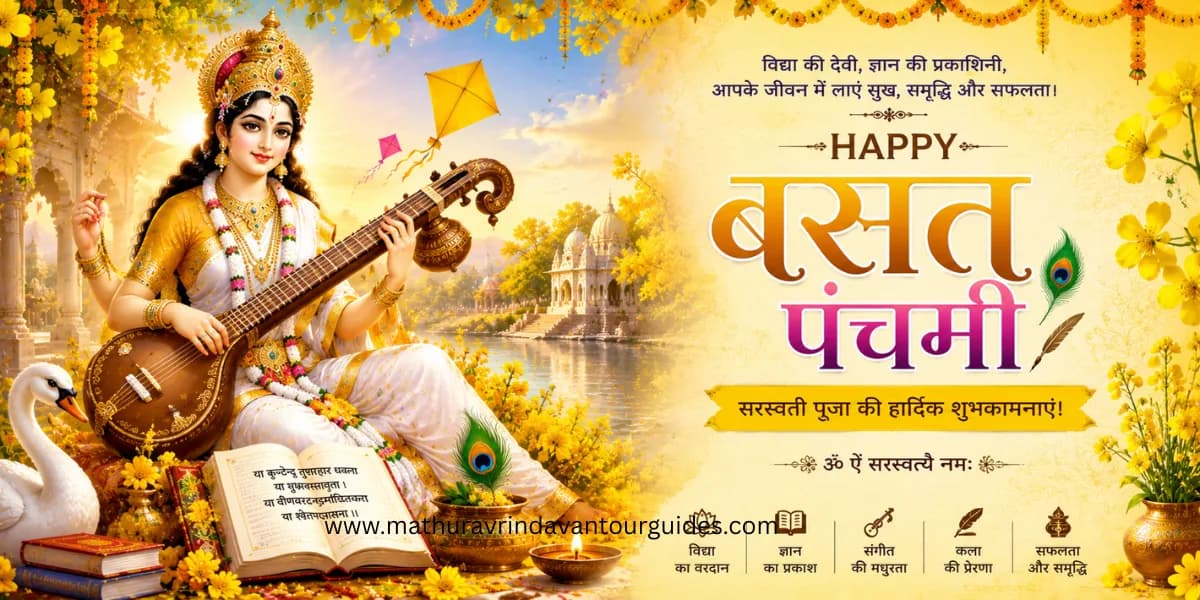
Basant Panchami is Saraswati's day — the goddess of learning, music and the arts. Students, musicians and artists worship her on this day. Books, instruments and artistic tools are placed before the goddess. It is considered the most auspicious day to begin learning a new skill or subject.
Kite flying on Basant Panchami is a centuries-old tradition across North India. The colourful kites against the February sky symbolise the lifting of winter. In Mathura and Vrindavan, the Yamuna ghats and open spaces fill with kite flyers in the afternoon.
In Braj, Basant Panchami is when the Holi preparations begin in temples. Traditionally, the deity of Banke Bihari is the first to play Holi on this day — with flowers and gentle colour — inaugurating the Holi season that builds to its climax five weeks later.
Banke Bihari Temple performs special Basant Panchami Shringar — the deity is adorned in yellow garments and decorated with yellow marigold garlands. The entire temple courtyard is decorated with yellow flowers, creating a vibrant spring atmosphere. The darshan on Basant Panchami at Banke Bihari — with the deity in brilliant yellow — is one of the most visually striking of the year.
Arrive early morning for a comfortable darshan before peak crowds. The yellow-adorned deity is a beautiful sight — managed darshan through Gate No. 5 recommended.
Banke Bihari's yellow Basant Panchami Shringar — the deity in full spring colours
ISKCON Krishna Balram Mandir holds a special Basant Panchami programme with kirtan, yellow flower decorations, special abhishek and cultural programmes. Well-organised and accessible for families and international visitors. The Radha Shyamasundar deity is adorned in yellow for this spring festival.
Best for families and first-time visitors — organised programme with English commentary. Check ISKCON website for the day's programme schedule.
ISKCON Basant Panchami morning programme — kirtan in the decorated temple courtyard
Prem Mandir is decorated with yellow flowers and spring decorations for Basant Panchami. The marble temple surrounded by yellow marigolds is extraordinarily beautiful. The evening programme at Prem Mandir on Basant Panchami includes special lighting and the spring atmosphere of the gardens.
Visit Prem Mandir in the late afternoon/evening for the spring decoration in the garden at its most beautiful. The marble exterior against yellow flowers is stunning for photography.
Prem Mandir's marble exterior surrounded by yellow marigold decorations on Basant Panchami
Radha Raman Mandir celebrates Basant Panchami with a more intimate traditional programme in the Gaudiya Vaishnava tradition. The deity is decorated in yellow and the morning puja includes yellow flowers and spring offerings.
For a quieter, more traditional Basant Panchami experience — Radha Raman is a lovely alternative to the busier temples.
The traditional Basant Panchami puja at Radha Raman — intimate and deeply devotional
The sky above Mathura's Yamuna ghats is filled with kites on Basant Panchami — the traditional day for kite flying across India. The colourful kites against the blue sky and the golden light of late winter is a joyful sight. Kite flying on Basant Panchami symbolises the arrival of spring and the lifting of the spirit.
Head to the Yamuna ghats in Mathura in the afternoon for kite flying. Kites and thread are sold at stalls near the ghats. A fun activity especially for children.
The sky full of kites over the Yamuna on Basant Panchami afternoon
Pre-dawn
First aarti of Basant Panchami at all Vrindavan temples. Deities adorned in yellow for the spring festival.
Morning
Goddess Saraswati is worshipped in homes and schools on Basant Panchami. Yellow flowers and yellow clothing are offered.
~8–11 AM
MAIN EVENT — Special yellow-adorned darshan at Banke Bihari, ISKCON and other temples. The deity in yellow is the defining image of Basant Panchami in Vrindavan.
Afternoon
Traditional kite flying at Mathura ghats and open spaces across Braj. The yellow and multicolour kites fill the winter sky.
~6:00 PM
Evening aarti at all temples. Prem Mandir's spring garden lighting on Basant Panchami evening is particularly beautiful.
8:00–11:00 AM
Morning — Yellow Temple Darshan
The morning of Basant Panchami in Vrindavan is bathed in yellow. Devotees dressed in yellow sarees and kurtas stream towards the temples with yellow marigold garlands as offerings. At Banke Bihari, the deity is adorned entirely in yellow — a sight that is uniquely associated with this festival. The atmosphere is joyful and the crowds are manageable compared to major festivals.
All morning
Yellow Marigold Offerings
Yellow marigold is the flower of Basant Panchami. Markets near temples overflow with yellow flower garlands on this day. The tradition of offering yellow flowers to the deity — whether at Banke Bihari, Radha Raman or ISKCON — connects the worshipper to the spring season. The fragrance of yellow marigold mixed with incense is the signature scent of Basant Panchami.
Morning
Saraswati Puja in Schools
Across Mathura, Vrindavan and all of Braj, schools and educational institutions hold Saraswati Puja on Basant Panchami. Students offer books and instruments to the Goddess of Learning. It is traditional on this day to not study — instead, books are placed before the Goddess and worshipped. The streets are filled with young people in yellow.
Afternoon
Kite Flying
The afternoon sky above Braj fills with kites on Basant Panchami — a tradition that connects spring's arrival with the lifting of the spirit. Yellow kites are particularly popular, as are all bright spring colours. The Yamuna ghats in Mathura are especially popular for kite flying. The sight of hundreds of kites against the clear February sky is joyful.
Delhi
~175 km
Train to Mathura Junction, then taxi to Vrindavan — 12 km. Total ~3 hrs.
Yamuna Expressway to Mathura then Vrindavan — ~3 hrs by car.
February is excellent weather for visiting Braj — cool and pleasant. No booking rush needed — book 1–2 weeks ahead.
Mathura
~12 km
Auto-rickshaw or taxi from Mathura station — 20–25 min.
Mathura–Vrindavan road — 20–25 min.
Mathura base is perfect — easy access to both Vrindavan temples and Mathura ghats for kite flying.
Agra
~75 km
Train to Mathura Junction, then taxi — ~2 hrs total.
Agra–Mathura–Vrindavan — ~1.5 hrs by car.
Great weather for Agra–Vrindavan combination in February. Taj Mahal + Basant Panchami — a beautiful 2-day trip.
Jaipur
~280 km
Train to Mathura Junction, then taxi — total ~4.5 hrs.
Jaipur–Agra–Mathura–Vrindavan — ~5 hrs by car.
February weather is ideal. A Jaipur–Agra–Vrindavan circuit in 3–4 days is one of the best Rajasthan–Braj itineraries.
With over 19 years of local expertise in Mathura and Vrindavan, we have served more than 38,000 happy devotees. Our 4.8/5 average rating reflects our commitment to providing authentic, comfortable, and memorable spiritual journeys in the sacred Braj region.
“Darshan is the essence of our yatra.”
Guides born and raised in Braj, not outsiders.
Every tour is designed around temple darshan and spiritual experience.
No hidden fees — clear, upfront pricing for all services.
Well-maintained vehicles with trusted drivers for safe travel.
Your spiritual journey is our top priority — we serve with devotion.
Always available to assist you before, during and after your tour.
We treat every yatra as a sacred seva, not just a tour package.
Guides born and raised in Braj, not outsiders.
Every tour is designed around temple darshan and spiritual experience.
No hidden fees — clear, upfront pricing for all services.
Well-maintained vehicles with trusted drivers for safe travel.
Your spiritual journey is our top priority — we serve with devotion.
Always available to assist you before, during and after your tour.
We treat every yatra as a sacred seva, not just a tour package.
भगवान श्री कृष्ण की कृपा से हर यात्रा सफल और सुखद होती है
We planned our Mathura Vrindavan trip with them and everything was handled very efficiently. Pickup, temple visits, and timing were all well managed. The journey felt smooth without any confusion.
Arjun Mehta
Mumbai
Coming from a different state, we were unsure about local arrangements. The team guided us properly and ensured we visited temples at the right time. It made the trip very peaceful.
Srinivas Reddy
Hyderabad
The tour plan was simple and comfortable. We had enough time for darshan and rest. It never felt rushed, which is important when travelling with family.
Ritu Saxena
Kanpur
The driver was experienced and knew all the routes well. We avoided traffic and reached temples at good times. The overall coordination was very good.
Debashish Ghosh
Kolkata
It was my first visit to Mathura Vrindavan and I didn't know how to cover everything. The itinerary made it easy and comfortable to visit all important places.
Vignesh Kumar
Chennai
Temple timings were planned very smartly. We reached early and avoided long queues. That made the darshan experience much better.
Simran Kaur
Amritsar
I travelled with elderly family members and the trip was planned with good balance. We never felt tired and everything was managed patiently.
Pradeep Yadav
Varanasi
The journey was organised and calm. We got enough time at each temple to experience the place properly. The overall trip felt well structured.
Anita Nair
Kochi
Hotel, travel, and temple visits were all coordinated properly. We didn't have to worry about anything and could focus on the spiritual part.
Manish Agrawal
Bhopal
Even during crowded hours, the team guided us well and managed everything smoothly. It made our visit comfortable and stress-free.
Sohini Chatterjee
Siliguri
Multiple temple visits were planned in a very organised way. The timing and travel routes were handled carefully to avoid delays.
Rakesh Naidu
Vijayawada
The experience felt genuine and well managed. It didn't feel rushed or commercial. Our Mathura Vrindavan trip was peaceful and memorable.
Pallavi Gupta
Gwalior
Basant Panchami (Vasant Panchami) is the festival marking the arrival of spring — celebrated on the fifth day (Panchami) of the bright fortnight of the month of Magha. It is associated with Goddess Saraswati (the goddess of learning, music and arts), with the colour yellow (representing the mustard flowers that bloom in spring across North India), and with kite flying. In the Braj tradition, Basant Panchami also marks the beginning of the Holi preparations — the famous Braj Holi season is traditionally inaugurated on this day.
Basant Panchami 2026 is expected to fall on approximately 2 February 2026. The date is determined by the lunar calendar as Magha Shukla Panchami.
Yellow is the colour of Basant Panchami for multiple reasons. The mustard flowers (sarson) that bloom across North Indian fields in late January–February are golden yellow — the entire Braj countryside turns yellow with mustard fields at this time of year. Yellow is also the colour of spring, knowledge and joy. Goddess Saraswati is depicted in white or yellow. Wearing yellow on Basant Panchami is considered auspicious and is a traditional practice across India.
Goddess Saraswati — the goddess of learning, knowledge, music and the arts — is traditionally worshipped on Basant Panchami. Students place their books, instruments and tools before the goddess and ask for her blessing. It is customary to not study on this day — instead, books are offered to the goddess. Schools and educational institutions across North India hold Saraswati Puja on Basant Panchami.
At Banke Bihari Temple on Basant Panchami, the deity is adorned in special yellow Shringar — yellow garments, yellow marigold garlands and yellow flower decorations. The entire temple is decorated with yellow flowers. Devotees come to offer yellow marigold garlands and receive the darshan of the spring-decorated deity. The yellow Shringar of Banke Bihari on Basant Panchami is one of the most beautiful seasonal darshans of the year.
Yes — Basant Panchami is one of the best times for first-time visitors and families. The weather in early February in Vrindavan is cool and pleasant (15–22°C). The festival atmosphere is joyful and accessible — crowds are manageable compared to major festivals like Janmashtami or Holi. The yellow-themed decorations in temples are beautiful, and the overall experience is easy to navigate.
The traditional offering on Basant Panchami is yellow marigold flowers — available from stalls near all Vrindavan temples. Yellow sweets (particularly kesar halwa made with saffron, or boondi ladoo) are offered. In the home, khichdi (a yellow rice and lentil preparation) is the traditional Basant Panchami offering. Some devotees also offer yellow silk cloth to the deity.
Basant Panchami marks the beginning of the Holi preparation season in Braj — it is the day when the spring/Holi season officially starts, and some temples begin their Holi preparations on this day. The actual Holi celebrations begin intensifying a few weeks later (Lathmar Holi at Barsana, Phoolon Ki Holi, and main Holi in March). Basant Panchami itself is primarily a yellow flower and Saraswati Puja day — the colour and playfulness of Holi develop gradually over the following weeks.
Discover Mathura Vrindavan – the divine land of Shri Krishna with peaceful darshan, expert local guides, and comfortable travel experiences.
Rated by 38,000+ devotees
Explore More Mathura Vrindavan Festivals
Basant Panchami in Vrindavan is one of the most colourful and inspiring festivals of Braj Bhoomi. The festival is to welcome the spring season and is dedicated to the Goddess Saraswati, the Goddess of wisdom, learning and arts. Basant Panchami is celebrated with devotion in Vrindavan and Mathura — temples are decorated with yellow flowers, Radha Krishna worship is performed, and devotional songs fill the air.
Temples in Vrindavan get enhanced with yellow flowers, yellow cloths, and other auspicious decorations during the festival to denote auspiciousness and prosperity. Devotees dress in yellow, offer sweets of the same colour to the deities, and sing devotional songs and take part in the festivities in the temple.
Mathura Vrindavan Tour Guides facilitates the pilgrims to enjoy the spiritual beauty of Basant Panchami through temple tours, local travel assistance, darshan guidance and Braj sightseeing support during the festival season.
Basant Panchami Festival 2026 in Vrindavan will be marked by traditional celebrations, devotional activities, and festive events throughout the Braj region. The festival is usually held in the Magha month as per Hindu Calendar at the beginning of spring.
During the day, the Mangla Aarti, offering of flowers, Saraswati Puja, devotional Bhajans and Radha Krishna Darshan are organised at the temples. Yellow flowers are used to decorate the temples and pujas are done for the deities.
Basant Panchami is a time when the devotees flock to the temple to perform rituals, offer their prayers, and enjoy the serene ambience of the holy city of Vrindavan.
In the temples of Vrindavan and Mathura, Basant Panchami is observed with enthusiasm and devotion. The festival is a reflection of happiness, knowledge, positivity and the onset of the spring season in Braj Bhoomi.
The idols of Radha Krishna are decorated in temples with yellow dresses and during the festival, yellow flowers, sweets, and traditional bhog are offered. Devotional songs, bhajans, kirtans and spiritual programmes are held throughout the day.
There are also many temples that hold Saraswati Puja ceremonies, in which devotees pray for wisdom, education and spiritual growth. During the festival, thousands of pilgrims and tourists come to the place, which is peaceful and filled with beautiful temple decorations.
A number of well-known temples of Vrindavan organize Basant Panchami with grandeur and organise devotional programmes. Banke Bihari Temple, one of the most popular temples during the festival, has grand flower decorations and a festive environment.
Other significant temples are ISKCON Vrindavan, Prem Mandir, Radha Raman Temple, Radha Vallabh Temple, Shahji Temple and Dwarkadhish Temple. The celebrations of Basant Panchami vary from temple to temple, as each one has its own set of traditions and rituals.
During the festival, visitors can enjoy devotional singing, flower showers, spiritual rituals, and peaceful darshan as they explore the temples in Vrindavan.
Banke Bihari Temple celebrates the festival of Basant Panchami with great devotion and thousands of devotees come to pay their respect during the festival period. Yellow flowers and yellow clothes are offered to Lord Banke Bihari Ji and various spring-themed decorations are used to embellish the temple.
Special Bhajans, Kirtans, Flower Puja and temple services are conducted throughout the day. Devotees come to the temple for darshan and to participate in various spiritual events, giving the temple a devotional atmosphere.
There is a lot of crowd during the evening hours during Basant Panchami, as people come to watch the beautiful decorations and devotional atmosphere in the temple.
ISKCON Vrindavan observes Basant Panchami with organized devotional activities, kirtans, Saraswati Puja and Radha Krishna worship. During the festival, people come to the temple from all over India and other countries.
Typically, Mangla Aarti, Guru Puja, Bhagavad Gita lectures, devotional singing, evening aarti, prasadam distribution and darshan of temples are included in the festival schedule.
The temple is beautifully decorated with flowers and yellow coloured decorations on the occasion of Basant Panchami. Devotees enjoy a peaceful and spiritual atmosphere thanks to continuous Hare Krishna Mahamantra chanting.
One of the key features of Basant Panchami in Vrindavan and Mathura is the wearing of a yellow dress. The colour yellow represents positivity, prosperity, wisdom, energy and the spring beauty.
During this festival, devotees wear yellow clothes and offer yellow flowers, sweets, saffron rice and turmeric coloured bhog to the deities. Yellow clothes and flowers are also used to adorn Radha Krishna idols in temples.
The spiritual essence of Basant Panchami is very much related to devotion, happiness, knowledge and celebration of the beauty of nature in Braj Bhoomi.
Basant Panchami in Braj Bhoomi is marked with special rituals, temple functions and devotional activities that are performed for Radha Krishna. The priests do the offering of flowers and temple aartis, perform bhajans and do spiritual ceremonies all day.
Devotional dance, cultural programmes and Rasleela activities based on Radha Krishna Leelas are organized by many temples. Celebrations are joyous and spiritually uplifting.
It is believed that doing the rituals of Basant Panchami in Braj leads to peace, positivity and divine blessings from Radha Krishna.
During Basant Panchami, it is best to visit Vrindavan in the early morning and evening hours when the temple is open for darshan. Throughout the day the temples are beautifully decorated and the spiritual activities continue.
Visitors are advised to come early to beat the crowd rush and enjoy sightseeing places and temples. The spring season weather also makes visits to temples and Braj Yatra a pleasant one.
With its colourful ambiance, devotional songs, and flower decorations, Basant Panchami is one of the most serene festivals to experience in Vrindavan.
Beautiful celebrations of Basant Panchami are organized by Prem Mandir and Radha Raman Temple with flower decorations, devotional singing and spiritual programs.
The festival evenings of Prem Mandir are illuminated with colourful lights, musical fountain shows and lovely decorations of the temple. The traditional Braj rituals are followed at Radha Raman Temple, and special darshan are held for devotees.
Both the temples provide a serene spiritual experience during Basant Panchami and visitors and tourists in huge numbers flock to the temples during the festival.
Thousands of devotees and tourists visit Vrindavan and Mathura in the spring season on the occasion of Basant Panchami. Hotels, dharamshalas and guest houses which are close to the main temples are usually booked full during festival days.
This makes it advisable for visitors to make their arrangements, including hotel and local travel, ahead of time to prevent travel difficulties during the festival period. E-rickshaws and local taxis are still available for sightseeing and visiting the temples.
Temple rules should also be adhered to by travelers and unnecessary valuables should not be carried during the darshan hours.
Saraswati Puja and Basant Utsav are significant aspects of the celebration of Basant Panchami in Mathura and Vrindavan. Goddess Saraswati is worshipped for wisdom, education, music and spiritual knowledge.
During the festival, there are Saraswati Puja ceremonies, devotional programs, bhajans, and cultural activities organized by temples and educational institutions. During the rituals, yellow flowers, books, musical instruments and traditional offerings are presented.
The festival brings a serene and celebrative spiritual vibe in the spring season in Braj Bhoomi.
Prior to visiting Vrindavan during Basant Panchami, it is crucial to plan for the congestion in temple premises and more tourist activity near popular temples.
It is recommended to wear comfortable clothes, water bottles, and basic traveling supplies. Moreover, it is advisable for the visitors to start visiting the temples early in the day for a hassle-free darshan and sightseeing.
Local guides can provide visitors with insights into temple traditions, festival rituals, and significant spiritual sites related to Basant Panchami celebrations.
A large number of visitors prefer to book their tour packages for Basant Panchami, for a comfortable and organized spiritual journey between Mathura and Vrindavan. Typically, temple visits, transportation, sightseeing, and accommodation assistance are all part of these packages.
Mathura Vrindavan Tour Guides offers personalized tour packages to Vrindavan, Mathura, Govardhan, Barsana and surrounding spiritual places for the festival of Basant Panchami.
During the festival season, visitors can experience guided tours of the temple, devotional experiences, local sightseeing, and peaceful Braj Yatra support.
The celebrations of Basant Panchami in Vrindavan are renowned for devotional songs (bhajans), yellow decoration of flowers and beautiful events in temples. During the festival, the temples conduct spiritual singing programmes, kirtans and showers of flowers.
Divine ambience prevails throughout Braj Bhoomi with fresh yellow flowers, marigold decorations, saffron coloured fabrics and the traditional decorations at the temples.
Basant Panchami is one of the most spiritually serene festivals of Vrindavan and Mathura because of devotional music, beauty of spring season, rituals in the temple and worship of Radha Krishna.