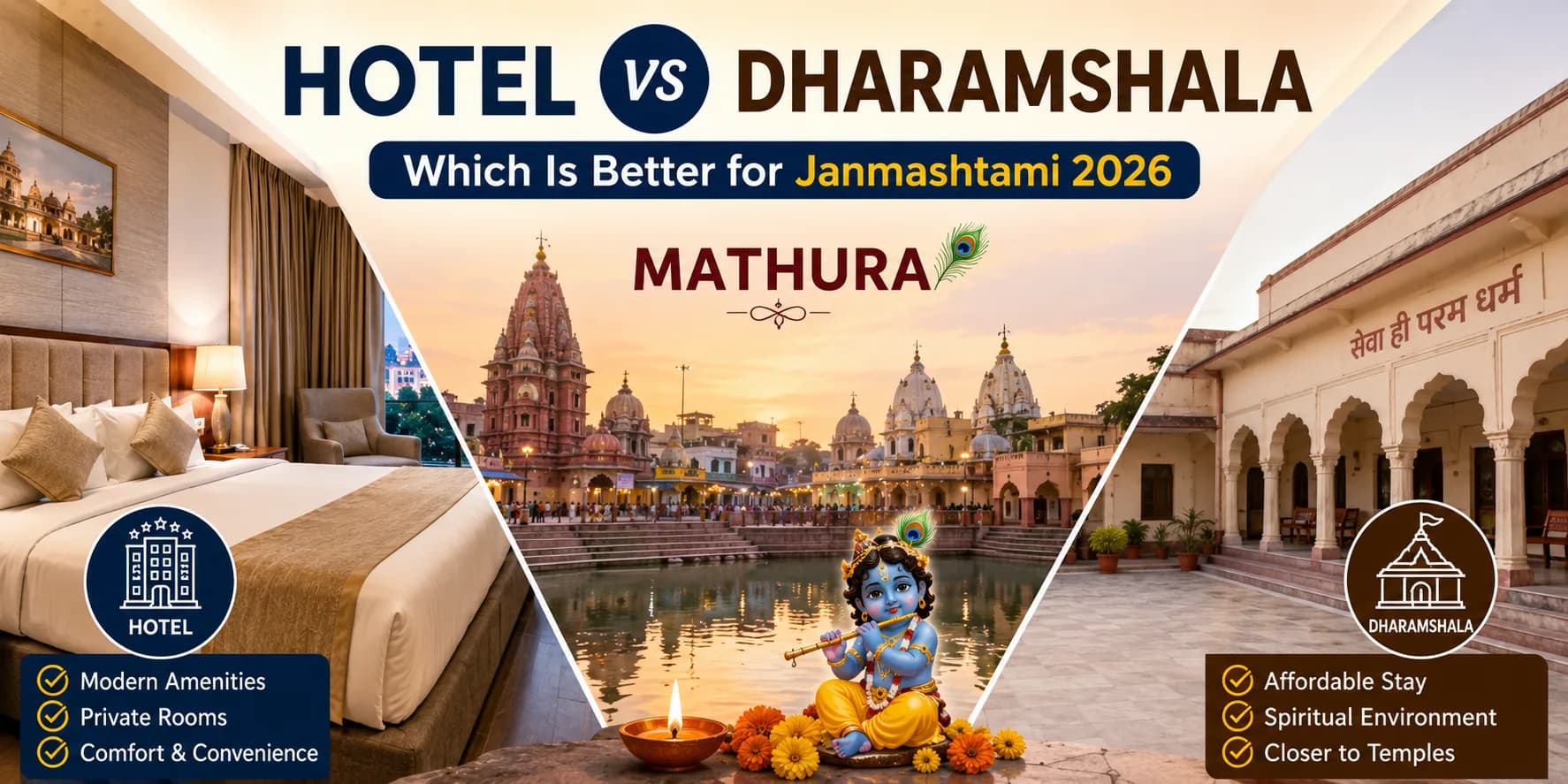
Hotel vs Dharamshala in Mathura: Which Is Better for Janmashtami 2026
Prateek Prasad
20 July 2026
Ready for your Braj Yatra?
Let us design the perfect pilgrimage package for you.
Janmashtami 2026 falls on Friday, September 4, with Ashtami Tithi running from 2:25 AM that day until 12:13 AM on September 5, and the sacred Nishita Kaal moment arriving around 12:26 AM. Mathura Vrindavan Tour Guides works with pilgrims every year to plan this exact trip, and the accommodation question always comes first. Vrindavan and Mathura pulled in nearly 6 million pilgrims on Janmashtami 2025 alone, up from 4.5 million the year before, so the choice between a hotel and a dharamshala shapes your comfort, your budget, and how close you get to the main temples during the festival's busiest hours. This guide compares both options on every factor that actually matters, backed by current pricing and crowd data, so you can book with confidence.
Janmashtami 2026 in Mathura: Dates and Crowd Numbers to Know
Janmashtami shifts every year because it follows the lunar calendar, and the scale of the crowd it draws explains why accommodation planning cannot wait until the last week. Uttar Pradesh's tourism department now treats this festival as its single biggest religious tourism event of the year, and the civic preparation behind it grows with every edition. These numbers set the real backdrop for your hotel-versus-dharamshala decision.
Janmashtami 2026 date: Friday, September 4
Ashtami Tithi: begins 2:25 AM on September 4, ends 12:13 AM on September 5
Nishita Kaal (the midnight birth moment): around 12:26 AM on September 5
Janmashtami 2024 footfall in Mathura-Vrindavan: over 4.5 million pilgrims
Janmashtami 2025 footfall: nearly 6 million pilgrims by 6 PM on the festival day, a new record
2025 civic scale: over 1,500 additional sanitation workers and 8 lakh litres of drinking water arranged for an expected 50 lakh visitors
This kind of volume pushes both hotels and dharamshalas toward full occupancy weeks or months ahead of the festival. Waiting until the last minute puts you at the back of a very long queue.
International arrivals add to this pressure every year. Devotees from Canada, the USA, France, Russia, and Nepal now travel to Mathura-Vrindavan specifically for Janmashtami, and this growing international interest pushes premium hotel categories toward capacity even faster than budget dharamshala rooms. If your travel dates sit close to September 4, treat both accommodation types as short-supply options rather than last-minute bookings you can sort out after you land.
What Sets a Dharamshala Apart From a Hotel in Mathura
A dharamshala runs on a completely different model than a commercial hotel, and understanding that difference helps you set the right expectations before you book. Religious trusts, temple bodies, and community organizations manage most dharamshalas in Vrindavan, and they build these properties specifically to house pilgrims rather than tourists. Hotels, by contrast, operate as standard commercial businesses that price rooms according to demand.
Purpose
Dharamshalas exist purely to support pilgrimage, so trusts keep charges low or link them to voluntary donations rather than open-market pricing. Hotels build their rates around occupancy and demand, the same way any commercial property does, so a Janmashtami stay costs noticeably more at a hotel than one built around temple seva.
Food
Dharamshalas serve sattvic vegetarian thalis in a shared dining hall at fixed meal times, and most trusts either include this in the room rate or charge a token amount per plate. Hotels near the temples also run vegetarian-only kitchens, but they price meals like a restaurant and give you more flexibility on timing and menu choice, including room service at several properties.
Atmosphere
Dharamshalas fill their corridors with satsangs, kirtans, and bhajans through the evening, and you end up sharing the stay with hundreds of fellow pilgrims who traveled for the same festival. Hotels keep that devotional energy at a distance, giving you a private room, a standard reception desk, and a stay that feels closer to any other commercial trip.
Rules
Dharamshalas apply the same rules to every guest regardless of who they travel with: modest dress throughout the premises, no alcohol on site, and at several trusts a gate that closes earlier than a typical city curfew. Hotels run on standard ID-based check-in and rarely restrict your movement, which gives you more freedom if your plans change or run late.
Booking process
Dharamshala trusts mostly handle bookings the traditional way, through a phone call or a visit to their office, and confirmation can take longer since these properties rarely list on third-party platforms. Hotels list openly across booking apps and websites, show real-time availability, and confirm your room instantly, which matters more during a festival where rooms disappear within hours.
Ownership
Trusts such as Jaipuria, Birla Mandir, and various Gaudiya Math institutions fund and run most dharamshalas as seva, and they put any surplus back into pilgrimage infrastructure rather than into profit. Every hotel in Vrindavan, whether an independent property or a branded chain, runs as a for-profit business that answers to occupancy targets and seasonal revenue rather than a devotional mandate.
Neither model works better in every situation. A dharamshala suits a pilgrim who wants to spend as little as possible on lodging and put that money toward temple seva instead, while a hotel suits a traveler who prioritizes comfort and convenience over cost.
Plan Your Janmashtami Trip for Mathura
Choosing the right accommodation is only one part of planning a smooth Janmashtami trip. During the festival, roads become crowded, parking is limited, and getting local transport at the last minute can be difficult. Instead of arranging hotels, taxis, and temple visits separately, many pilgrims prefer booking a complete tour package.
A professionally planned tour package helps you focus on the spiritual experience while the travel arrangements are taken care of.
Benefits of Booking a Tour Package During Janmashtami
- Comfortable AC cab for local sightseeing
- Hotel booking assistance based on your budget
- Temple darshan planning to avoid unnecessary delays
- Pickup and drop from Mathura Railway Station or nearby cities
- Local driver familiar with festival routes
- Suitable for families, senior citizens, and group travelers
- Flexible itineraries for one-day, two-day, and customized tours
Whether you choose a hotel for extra comfort or a dharamshala for a devotional stay, a guided tour package can make your Janmashtami journey much more convenient.
Explore the Mathura Vrindavan Tour Packages to find customized pilgrimage packages with accommodation, sightseeing, and local transportation for a hassle-free Janmashtami experience.
Hotel vs Dharamshala in Mathura: Price Comparison
Budget drives most of this decision, and the gap between the two options runs wider than many first-time pilgrims expect. Dharamshalas publish a fixed rate card that barely moves through the year, while hotel prices swing hard around major festival dates.
Room Type | Dharamshala Price (per night) | Hotel Price (per night) |
Dormitory / shared hall bed | ₹250 – ₹600 | Rarely available |
Non-AC private room | ₹500 – ₹900 | ₹800 – ₹2,000 |
AC private room | ₹900 – ₹1,500 | ₹2,500 – ₹5,000 |
Premium / deluxe room | Limited availability | ₹5,000 – ₹10,000+ |
Hotel rates in Vrindavan can climb two to three times their normal price during major festival weeks, while dharamshala rate cards mostly hold steady through the same period. Availability shrinks either way as September 4 gets closer, so an early booking protects both your budget and your room.
Stretch this across a typical three-night Janmashtami visit and the gap becomes obvious. A dharamshala stay works out to roughly ₹750 to ₹4,500 in total for three nights, while the equivalent hotel stay runs anywhere from ₹2,400 to ₹15,000 or more, depending on the room category and how close your dates sit to September 4.
Comfort and Amenities in Mathura
Price only tells half the story, and comfort levels vary sharply once you look past the nightly rate. Weigh these factors against how you actually plan to spend your Janmashtami trip
Amenity | Dharamshala | Hotel |
Air conditioning | Only in premium rooms | Standard in most rooms |
Private bathroom | Common in paid rooms, shared in dorms | Standard across room types |
Wi-Fi | Rare or unreliable | Usually available |
On-site vegetarian food | Included or low-cost | Available, priced separately |
Late-night re-entry after Nishita Kaal darshan | Restricted at several trusts | Generally open round the clock |
Parking | Available, often free | Available, sometimes paid |
The late-night re-entry point deserves special attention. Janmashtami's Nishita Kaal darshan runs well past midnight, and many dharamshala trusts close their gates earlier than that hour. Confirm the exact gate timing with your dharamshala before you book, or pick a hotel instead if you plan to attend the midnight aarti and return afterward.
Quiet hours follow a similar pattern. Dharamshala trusts generally enforce quiet hours earlier in the evening than hotels do, which suits families with young children or elderly members who need an early wind-down but works against anyone planning to stay out through the midnight celebrations.
Location and Proximity to Temples During Janmashtami
Distance from the main temples decides how much walking, traffic, and crowd navigation you handle during the festival's busiest hours. Fortunately, both hotels and dharamshalas cluster around Vrindavan's key pilgrimage points, so location alone should never override your comfort and budget priorities.
Banke Bihari Temple
Draws the single largest Janmashtami crowd in Mathura and sits inside the most congested lanes of the old town. The temple's iconic curtain ritual, where priests repeatedly open and close the curtain in front of the deity, slows an already massive queue even further during festival week. Pilgrims who choose a stay close to this temple should expect to walk the last stretch on foot, since vehicles cannot enter the narrow lanes around it during peak hours.
ISKCON Vrindavan
(Sri Sri Krishna Balaram Mandir) hosts a large international pilgrim base and runs a well-organized Janmashtami program with easier crowd flow. The complex sits on wider roads than the old town, so it manages queues through barricading and timed darshan slots instead of letting crowds bottleneck in narrow lanes. Its Janmashtami mahotsav includes structured kirtan sessions and a midnight abhishek that draws devotees from across the world alongside a large number of domestic pilgrims.
Prem Mandir
Prem Mandir elaborate light and darshan program and sits slightly outside the old town, which eases the crowd pressure around it. The temple's evening light-and-fountain show turns into one of the festival's biggest draws, and its wide marble courtyards handle large Janmashtami crowds far better than the narrow lanes near Banke Bihari. Pilgrims who want festival spectacle without the tightest crowd crush often prioritize a stay near this temple.
Krishna Janmabhoomi
Mathura draws its own massive crowd and works best as a separate day trip from your Vrindavan base rather than a same-day stop. Security checks here run stricter than at the Vrindavan temples, and the complex typically restricts phones and cameras inside, so budget extra time for entry alone. Janmabhoomi sits in Mathura city rather than Vrindavan, so treat it as its own outing on the itinerary instead of squeezing it between temple visits on the main festival night.
Our detailed guide to Janmashtami in Mathura walks through each temple's festival-day schedule in more depth. Most hotels and dharamshalas sit along Parikrama Marg, Raman Reti Road, and the Prem Mandir belt, so choose your base by darshan sequence rather than accommodation type alone.
Booking Rules and Availability During Peak Festival Days
Janmashtami booking behaves nothing like an ordinary weekend trip, and both accommodation types demand earlier action than most first-time visitors expect. Understanding these rules now saves you from a stressful search in late August.
Dharamshala trusts often fill their Janmashtami rooms up to six months in advance, especially AC and family rooms.
Hotel rates rise steadily as the festival date approaches, so an early booking saves money along with securing the room itself.
Dharamshalas rarely process reservations through third-party apps during festival weeks; confirm your booking directly with the trust office.
Hotels closest to Banke Bihari and ISKCON sell out fastest because of their walking-distance convenience.
Large families and yatra groups typically get better per-head rates at dharamshala halls than at equivalent hotel bookings.
Local taxis and e-rickshaws also run at a premium around Janmashtami, so factor last-mile transport cost into your accommodation budget alongside the room rate itself.
Which One Should You Choose for Janmashtami 2026
Your final choice comes down to budget, comfort priorities, and how you plan to move through the festival's midnight schedule. Neither option beats the other on every count, so match your travel style against this breakdown before you lock in a booking rather than defaulting to whichever option a friend recommends.
Choose a Hotel If | Choose a Dharamshala If |
You want AC, a private bathroom, and standard hotel comfort | You want the lowest possible cost per night |
You plan to return late after the Nishita Kaal darshan | You want a shared devotional atmosphere with fellow pilgrims |
You travel with young children or elderly family members | You travel with a large yatra group and need bulk-rate rooms |
You want flexible, ID-based check-in with fewer restrictions | You are comfortable with vegetarian-only, alcohol-free premises |
Many pilgrim families split the difference: they book a hotel for the main Janmashtami night for comfort and easy late-night re-entry, then move to a dharamshala for the quieter days around it. This approach balances cost against comfort across the full trip instead of forcing a single choice for every night.
Final Thoughts
Mathura will host millions of devotees again this September, and rooms across both hotels and dharamshalas will disappear fast as the festival date approaches. Lock in your accommodation now, weigh it against the price and comfort factors above, and confirm gate or re-entry timing directly if you choose a dharamshala.
Mathura Vrindavan Tour Guides books verified hotel and dharamshala stays for Janmashtami 2026, alongside temple darshan planning and local transport across Mathura and Vrindavan. Contact us today and secure your place in Mathura before the festival rush begins.