Best Time to Visit Mathura Vrindavan: Month-Wise Guide
Sanskriti Kumari
11 August 2026
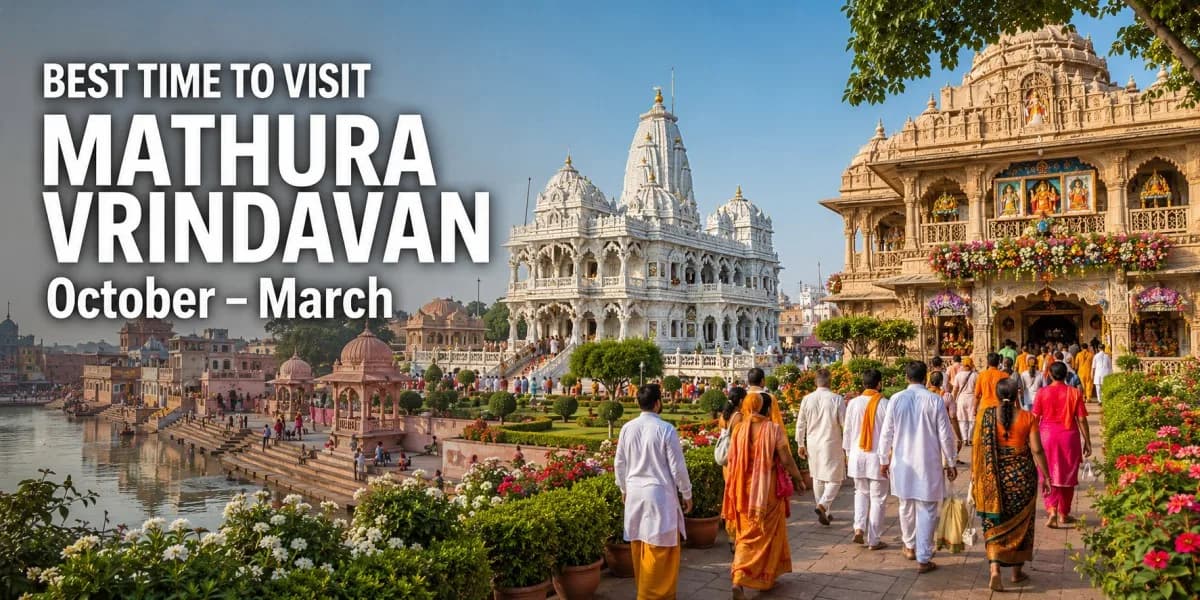
The best time to visit Mathura Vrindavan is October to March, when daytime temperatures are generally more comfortable for visiting Banke Bihari Temple, Prem Mandir, Krishna Janmabhoomi and Vishram Ghat. October and November suit temple sightseeing, while February and March are popular for Holi celebrations in Braj. Summer from April to June is hot, with daytime temperatures often above 35°C, while July to September brings monsoon rain.
Ready for your Braj Yatra?
Let us design the perfect pilgrimage package for you.
The best time to visit Mathura Vrindavan is October to March if you want comfortable weather for temple visits, walking through Vrindavan's narrow lanes and exploring Mathura's ghats. However, the ideal month depends on your priority: October to November is good for sightseeing, December and January are cooler, February and March are important for Holi, and July to September offers greener surroundings with occasional rain. As someone who works in Braj, I recommend planning around both weather and festival crowds rather than choosing a month based on temperature alone.
Quick Answer: When Is the Best Time to Visit Mathura Vrindavan?
The best time to visit Mathura Vrindavan is October to March, when the weather is generally more suitable for temple visits and local sightseeing. February and March are particularly busy because of Braj Holi, while August and September bring Janmashtami and Radhashtami crowds. April to June can be very hot, with daytime temperatures often reaching or exceeding 40°C, so summer sightseeing is better planned for early morning and evening.
Travel Period | Weather | Crowd Level | Best For |
|---|---|---|---|
October–November | Pleasant | Moderate to high | Temples, ghats, sightseeing |
December–January | Cool to cold | Moderate | Temple visits and parikrama |
February–March | Pleasant to warm | Very high around Holi | Holi and Braj festivals |
April–June | Very hot | Lower | Early morning darshan |
July–September | Humid, occasional rain | Moderate | Greenery and quieter visits |
Festival dates | Varies | Very high | Traditional celebrations |
Why Is October to March the Best Time to Visit Mathura Vrindavan?
October to March is generally the easiest season for a full Braj pilgrimage. The cooler weather makes it more practical to walk between temples, visit the ghats and spend time outdoors without the intense heat experienced in May and June.
In Vrindavan, many important temples are located within relatively compact but congested areas. Banke Bihari Temple, Radha Raman Temple, Nidhivan and Radha Damodar Temple are best approached with some walking because vehicles cannot move freely through every narrow lane.
October also marks the beginning of a busy festival period. Govardhan Puja, Annakut, Kartik month and other religious occasions can increase visitor numbers. November is particularly important for devotees who want to experience the traditional Kartik atmosphere, while December and January offer cooler conditions.
For travellers who prefer a structured pilgrimage, a 2 Days Mathura Vrindavan Tour Package gives enough time to cover the principal temples without compressing the itinerary into a single day.
Is Winter a Good Time to Visit Mathura and Vrindavan?
Yes, winter is one of the most comfortable periods for visiting Mathura and Vrindavan, although December and January mornings can be quite cold. The lower temperatures are particularly useful for travellers planning temple circuits, walking tours or Govardhan Parikrama.
A winter itinerary can include Shri Krishna Janmabhoomi and Dwarkadhish Temple in Mathura before moving towards Vrindavan for Banke Bihari Temple, Radha Raman Temple and Prem Mandir.
Month | Typical Experience | Travel Advice |
|---|---|---|
October | Pleasant and gradually cooler | Good for sightseeing |
November | Comfortable, festival activity | Good for temples and ghats |
December | Cool mornings and evenings | Carry warm layers |
January | Coldest period | Carry a jacket or shawl |
February | Pleasant and increasingly warm | Excellent before Holi crowds |
At Vishram Ghat in Mathura, winter evenings can be cool, particularly while waiting for the Yamuna Aarti. If you plan to stay near the river after sunset, carry an extra layer.
When Should You Visit Mathura Vrindavan for Holi?
Visit in February or March if your main purpose is to experience Braj Holi, but expect exceptionally heavy crowds. Holi in Braj is not limited to a single day. Celebrations take place across Mathura, Vrindavan, Barsana, Nandgaon and other surrounding locations over several days.
Barsana is particularly known for Lathmar Holi, while Vrindavan has its own temple-based celebrations. Banke Bihari Temple becomes extremely crowded during the main Holi period.
If Holi is not your main reason for travelling, I generally recommend avoiding the peak celebration dates and choosing a nearby weekday. This gives you better access to temples and makes local road travel easier.
For devotees planning a festival trip, the site's Janmashtami and Mathura Vrindavan Festival Guide can also help with understanding how crowd levels change around major celebrations.
What Is the Best Time to Visit Mathura Vrindavan for Janmashtami?
The best time for Janmashtami depends on whether you want the festival atmosphere or a quieter pilgrimage. August is the main period, but Janmashtami attracts extremely large crowds around Shri Krishna Janmabhoomi in Mathura, Banke Bihari Temple and ISKCON Vrindavan.
At Krishna Janmabhoomi, the midnight celebration is the central event. In Vrindavan, ISKCON also holds extensive devotional programmes, while Banke Bihari Temple has special arrangements.
Festival timings, entry procedures and security arrangements can change, so visitors should not plan around a guaranteed darshan time.
If you intend to travel during Janmashtami, accommodation and transport should be arranged well in advance. The dedicated Janmashtami in Mathura and Vrindavan 2026 guide provides festival-specific information and planning advice.
Is Summer a Good Time to Visit Mathura Vrindavan?
Summer from April to June is generally the least comfortable season for extensive daytime sightseeing because temperatures can become very high. By May and June, daytime temperatures can reach around 40°C or higher.
However, summer does not mean that a pilgrimage is impossible. The practical approach is to schedule the main temple visits early in the morning, take a break during the hottest part of the afternoon and resume sightseeing later.
For example, you can visit Krishna Janmabhoomi and Dwarkadhish Temple in the morning, rest during the afternoon and then visit Prem Mandir later in the day.
Summer Period | Recommended Approach |
|---|---|
5:00–9:00 AM | Main temple visits |
9:00 AM–1:00 PM | Limited outdoor activity |
1:00–4:00 PM | Rest or indoor activities |
4:00–8:00 PM | Evening temples and ghats |
Carry water, use sun protection and wear light, breathable clothing. Older travellers and young children may find summer afternoons particularly tiring.
What Is Mathura Vrindavan Like During the Monsoon?
July to September brings monsoon conditions, with humid weather and occasional rainfall. The region becomes greener, and some visitors prefer this period because it can feel quieter than the major festival months.
Rain can, however, affect walking through Vrindavan's older lanes and can slow road travel. Carrying an umbrella or lightweight rain protection is sensible.
Monsoon can be a good choice if you want a less crowded pilgrimage and are comfortable adjusting your schedule around rainfall. Jhulan Yatra and Janmashtami can also bring increased crowds during this period, so festival dates should be checked separately.
Which Months Are Best for Temple Visits Without Festival Crowds?
For travellers who want a balance between comfortable weather and manageable crowds, late October, November, early December and parts of January can work well, subject to local festival dates.
There is no month when every temple remains consistently quiet. Banke Bihari Temple can become busy even on ordinary weekends, and popular evening periods at Prem Mandir also attract substantial numbers.
A weekday visit is generally preferable to a Saturday, Sunday or public holiday. Starting early also gives you more flexibility later in the day.
The current Mathura Vrindavan tour information recommends October to March for comfortable temple visits and notes that early mornings and weekdays are generally preferable for a calmer experience.
What Is the Best Time of Day to Visit Banke Bihari Temple?
There is no guaranteed low-crowd hour at Banke Bihari Temple, but early morning on a weekday is generally a more practical choice than a weekend or major festival period. The temple's seasonal schedule changes, and visitors should confirm the current timings before travelling.
Banke Bihari Temple is located in the old Vrindavan area, where roads become congested quickly. Even when the vehicle reaches the nearest accessible point, some walking through the lanes is normally required.
If you are considering managed darshan assistance, understand the distinction between an official temple ticket and a coordinated service. Banke Bihari Temple does not sell a regular public VIP ticket system; any managed arrangement should be clearly explained before booking.
When Is the Best Time to Visit Prem Mandir?
Late afternoon and evening are popular for Prem Mandir because visitors can see the temple in daylight and later experience its illuminated exterior. The temple is approximately 2.5 kilometres from Banke Bihari Temple by road.
Prem Mandir's white marble architecture is especially visible in daylight, while the evening illumination gives the complex a different appearance. Allow additional time at weekends and during festival periods because visitor numbers increase.
A practical Vrindavan itinerary can place Banke Bihari Temple earlier in the day and Prem Mandir later, reducing unnecessary movement between different parts of the town.
Can You Visit Mathura and Vrindavan in One Day?
Yes, you can visit the main attractions of both cities in one day, but the itinerary needs to remain focused. A typical route from Delhi can begin at Shri Krishna Janmabhoomi and Dwarkadhish Temple in Mathura, followed by Banke Bihari Temple, ISKCON Vrindavan and Prem Mandir.
For a more relaxed pilgrimage, two days are preferable because Mathura and Vrindavan contain numerous temples and sacred sites.
A 1 Day Vrindavan Tour Package from Delhi is more suitable if your priority is Vrindavan rather than trying to cover the entire Braj region in one day. For a fuller itinerary, the 2 Days Mathura Vrindavan Tour Package allows additional time for temples and the Yamuna ghats.
What Is the Best Time for a Complete Braj Yatra?
If you want to go beyond Mathura and Vrindavan to Govardhan, Barsana, Nandgaon and Gokul, October to February is generally the most practical period because the weather is more suitable for longer road journeys and outdoor visits.
A longer circuit can include:
Place | Approximate Distance from Mathura | Main Attraction |
|---|---|---|
Vrindavan | 12–15 km | Banke Bihari Temple |
Gokul | 10–12 km | Nand Bhavan and Krishna traditions |
Govardhan | 25 km | Govardhan Hill and Parikrama |
Barsana | 50 km | Radha Rani Temple |
Nandgaon | 50–55 km | Nand Bhavan |
Distances vary according to the exact starting point and route.
For devotees wanting a broader Braj pilgrimage, the 5 Days Braj 84 Kos Yatra Package covers places such as Govardhan, Barsana, Nandgaon and Radha Kund. The package is listed among the site's current pilgrimage options.
When Should Families with Children and Senior Citizens Visit?
Families with children and senior citizens generally find October to March more comfortable than the summer months. Weekdays are preferable because the main temple areas can become congested at weekends.
I also recommend keeping the daily itinerary realistic. Visiting five or six temples without breaks can be tiring, particularly for older travellers. Banke Bihari Temple involves navigating crowded lanes, while Govardhan Parikrama requires considerably more physical effort if undertaken on foot.
For families, a private vehicle can make the journey easier between Mathura, Vrindavan and the surrounding Braj towns, although it cannot eliminate walking inside restricted temple areas.
Which Month Should You Avoid for a Quiet Pilgrimage?
If your priority is a quiet pilgrimage, avoid the main Holi and Janmashtami periods, as well as major festival dates around Radhashtami and Govardhan Puja. These occasions are important religiously but bring substantial visitor numbers.
Summer afternoons from April to June are also unsuitable if you want to spend long periods outdoors, although early morning visits can still work.
The quietest experience is usually achieved by combining a non-festival weekday with an early start. Even then, Banke Bihari Temple and other major temples can become busy without warning, so visitors should allow flexibility rather than planning an exact darshan duration.
What Should You Consider Before Choosing Your Travel Month?
The best time to visit Mathura Vrindavan depends on four practical factors: weather, festival dates, crowd levels and the type of pilgrimage you want.
Your Priority | Recommended Period |
|---|---|
Comfortable sightseeing | October–March |
Cooler weather | December–January |
Holi celebrations | February–March |
Janmashtami celebrations | August |
Fewer festival crowds | Non-festival weekdays |
Summer pilgrimage | Early morning and evening |
Green monsoon landscape | July–September |
Govardhan Parikrama | October–February |
If you are travelling from Delhi and want a longer multi-city pilgrimage, the 6 6 Days Mathura Vrindavan Ayodhya Varanasi Tour Package combines Braj with Ayodhya and Varanasi. The current package listing includes Mathura and Vrindavan along with Ram Janmabhoomi, Kashi Vishwanath and Ganga Aarti.
Conclusion
The best time to visit Mathura Vrindavan is October to March for most travellers, particularly those who want comfortable weather for temple visits, walking and sightseeing. However, February and March are better suited to travellers specifically seeking Braj Holi, while August and September are important for Janmashtami and Radhashtami.
For a quieter pilgrimage, choose a weekday outside the major festival periods and begin temple visits early. For summer travel, limit outdoor sightseeing to morning and evening. Most importantly, keep your itinerary flexible because temple crowds, local traffic, security arrangements and darshan procedures can change during the day.
Contact Mathura Vrindavan Tour Guides
Detail | Information |
|---|---|
Brand | Mathura Vrindavan Tour Guides |
Website | |
Phone | +91 9058430503 |
Location | Vrindavan, Uttar Pradesh |
Services | Mathura and Vrindavan pilgrimage tours, Braj Yatra, private cabs, temple assistance and customised itineraries |