Sacred Fasting Day · Twice Monthly · Parikrama · 2026
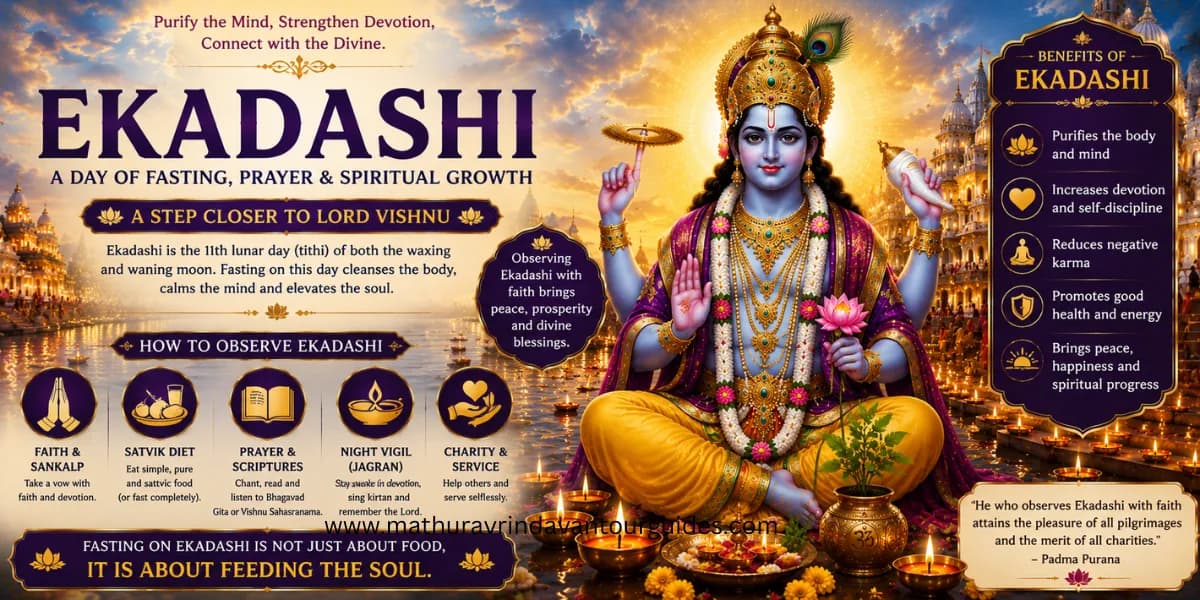
Ekadashi — the 11th lunar day — is the most sacred fasting day in the Vaishnava tradition, occurring twice monthly. In Vrindavan, Ekadashi brings 2–3 times the normal pilgrims, pre-dawn Parikrama, extraordinary temple darshan and all-night kirtan. The 24 Ekadashis of the year are all special — and in Braj, they are all observed.
Quick Answer — Ekadashi in Vrindavan
Frequency
Twice monthly — every 11th lunar day
Nirjala Ekadashi
~June 2026 — most sacred
Devshayani Ekadashi
~July 2026 — Lord Vishnu sleeps
Prabodhini Ekadashi
~November 2026 — Vishnu awakes
Crowd Level
2–3x normal on Ekadashi days
Fasting
From previous evening (Dashami)
Break Fast
Next morning (Dwadashi)
Nearest Station
Mathura Junction — 12 km from Vrindavan
Book Darshan
Essential on Ekadashi — long queues
Parikrama
Thousands do Vrindavan Parikrama on Ekadashi
Entry Fee
Free at all temples
Best For
Spiritual retreat + intense darshan experience
Ekadashi — the 11th lunar day — is described in the Padma Purana as the most pleasing day to Lord Vishnu. The practice of fasting on Ekadashi and engaging in devotional activities is said to yield more spiritual merit than any other form of austerity. In Vrindavan — the most sacred Vaishnava pilgrimage city — Ekadashi is observed with extraordinary intensity.
There are 24 Ekadashis in a year (25 in a lunar leap year), each with its own name and story. The most important are Nirjala Ekadashi (the strictest fast — no water), Devshayani Ekadashi (when Vishnu enters his yogic sleep), Prabodhini Ekadashi (when he awakens) and Vaikunta Ekadashi (associated with liberation).
In Vrindavan on Ekadashi, the normal pilgrimage population swells 2–3 times. Pre-dawn Parikrama is performed by thousands. All-night kirtan echoes from the temples. The collective devotional energy of an Ekadashi in Vrindavan is one of the most powerful spiritual experiences available in Braj.
Ekadashi fasting involves avoiding grains, beans and certain vegetables. Fruits, dairy, nuts, root vegetables (excluding onion, garlic) and pure water are permitted. Special Ekadashi foods — sabudana (sago), kuttu (buckwheat), sweet potato, fruits — are widely available in Vrindavan's restaurants and sweet shops on Ekadashi.
The Ekadashi fast is broken on the next morning (Dwadashi) at a specific time window called 'parana' — which is calculated based on Dwadashi sunrise and the time when Dwadashi tithi ends. Breaking the fast before or after the parana window is considered inauspicious. ISKCON publishes exact parana times for each Ekadashi.
Each of the 24 Ekadashis in the year has a name and an associated Puranic story. The most important for Vrindavan pilgrims: Nirjala (strictest, June), Devshayani (Vishnu sleeps, July), Prabodhini (Vishnu wakes, November), Vaikunta (liberation, December). Our guides know all the Ekadashi dates for 2026.
Performing the full 10 km Vrindavan Parikrama on Ekadashi is one of the most meritorious acts in the Braj tradition. Thousands of devotees walk the circuit from pre-dawn, chanting Hari Naam. The Parikrama Marg passes through Keshi Ghat, Nidhivan, Seva Kunja and all the major sacred areas of Vrindavan.
Banke Bihari Temple on Ekadashi is one of the most intense crowd experiences in all of Vrindavan. The queue for darshan regularly extends to 3–4 hours on major Ekadashi days. Despite — or because of — the crowds, the devotional energy inside the temple on Ekadashi is extraordinary. The extended darshan hours and special Ekadashi Shringar of the deity make this the most sought-after Ekadashi experience in Vrindavan.
Arrive at Banke Bihari by 5 AM on major Ekadashi days for a manageable wait. Managed darshan through Gate No. 5 is essential. For Nirjala and Prabodhini Ekadashi, arrive even earlier.
Banke Bihari Ekadashi Shringar — the deity in special Ekadashi attire with extended darshan
ISKCON Vrindavan holds special Ekadashi programmes with the traditional fast-breaking at the correct Dwadashi time the next morning, all-night kirtan (Raas), special Ekadashi aarti, Bhagavat Katha and prasad distribution of Ekadashi food (which excludes grains). The organised format makes ISKCON the most accessible Ekadashi experience for international visitors and those new to the tradition.
ISKCON's Ekadashi programme is well-structured with clear timings. The all-night kirtan on special Ekadashis like Nirjala and Prabodhini is particularly powerful.
ISKCON Ekadashi all-night kirtan — devotees chanting continuously through the night
Radha Raman Mandir — with its continuous tradition of Ekadashi observance maintained by the hereditary Goswami priests since 1542 AD — offers one of the most authentic Ekadashi experiences in Vrindavan. The traditional ceremonies and the intimate atmosphere of this ancient temple make Ekadashi here deeply meaningful.
Arrive at Radha Raman for early morning Ekadashi darshan (5:30–7:30 AM) for a less crowded but deeply devotional experience. The traditional Goswami ceremonies are uniquely moving.
Radha Raman Ekadashi early morning darshan — 500-year-old traditions observed without interruption
Performing the Vrindavan Parikrama (10 km circumambulation of Vrindavan) on Ekadashi is considered one of the most meritorious acts in the Braj tradition. Thousands of devotees walk the parikrama road on Ekadashi, particularly on major Ekadashis like Nirjala and Prabodhini. The parikrama route passes through sacred groves, ghats and temple areas.
Best time for Ekadashi Parikrama: pre-dawn (4–7 AM) or late afternoon (4–6 PM). Carry water and comfortable walking shoes — the 10 km circuit takes 2.5–3 hours.
Pre-dawn Ekadashi Parikrama — thousands of devotees walking in the darkness, chanting Hari Naam
Krishna Janmabhoomi — the birthplace of Lord Krishna in Mathura — holds special Ekadashi programmes with extended darshan hours and special aarti. Combining Mathura Janmabhoomi darshan with Vrindavan temple darshan on Ekadashi is a recommended full-day Ekadashi pilgrimage circuit.
Combine Mathura Janmabhoomi morning darshan with Vrindavan temple darshan and Keshi Ghat for a complete Ekadashi day in Braj.
Mathura Janmabhoomi special Ekadashi aarti — the birthplace of Krishna on the most sacred fasting day
Previous evening
The Ekadashi fast traditionally begins from Dashami (10th lunar day) evening — no grains eaten from this point. Preparation for the Ekadashi vrat.
4:00–7:00 AM
Thousands of devotees walk the Vrindavan Parikrama in the pre-dawn hours of Ekadashi. The darkness before dawn, filled with the sound of Hari Naam, is deeply powerful.
5:30–6:00 AM
First aarti of Ekadashi at all Vrindavan temples. The temples are more crowded than usual from this hour onwards.
6:00 AM–12 PM
MAIN EVENT — Temple darshan throughout the morning. Banke Bihari, Radha Raman, ISKCON all hold special Ekadashi programmes with extended hours.
Afternoon
Bhagavat Katha sessions at ISKCON and other venues. The afternoon of Ekadashi is traditionally spent in hearing sacred texts.
Evening onwards
On major Ekadashis (Nirjala, Prabodhini), all-night kirtan (Raas) is held at ISKCON and other temples. Devotees chant through the night until the fast is broken on Dwadashi morning.
4:00–7:00 AM
Pre-Dawn — The Sacred Hours
The pre-dawn hours of Ekadashi in Vrindavan are among the most spiritually charged in the Braj calendar. Thousands of devotees are already walking the Parikrama road, chanting Hari Naam in the darkness. The sound of kirtan coming from temples that have been open since Mangala Aarti fills the air. For those serious about the Ekadashi experience, beginning before dawn is the most rewarding approach.
5:30 AM – 12:00 PM
Morning Temple Darshan
Morning darshan on Ekadashi at the major Vrindavan temples requires patience — the crowds are typically 2–3 times the normal level. At Banke Bihari, queue times of 2–4 hours are common on major Ekadashis. At Radha Raman, early morning (5:30–7:30 AM) offers a more intimate and less crowded experience. ISKCON holds a structured morning programme accessible to all.
Any time — best pre-dawn or late afternoon
Vrindavan Parikrama
The Vrindavan Parikrama — 10 km circumambulation of the entire sacred city — is the traditional Ekadashi practice of Braj. Performing this on Ekadashi is considered especially meritorious. The parikrama route passes through the main sacred areas: Keshi Ghat, Nidhivan, Seva Kunja, Kaliya Ghat and through the Parikrama Marg that encircles the city.
Afternoon
Bhagavat Katha & Bhajans
The afternoon of Ekadashi in Vrindavan is traditionally spent in hearing sacred texts — Bhagavat Katha. ISKCON holds regular Ekadashi Katha sessions. The connection between fasting and the hearing of sacred texts is central to the Ekadashi vrat — the emptiness of the body is meant to be filled with divine sound.
Delhi
~175 km
Train to Mathura Junction, then taxi to Vrindavan — 12 km. Total ~3 hrs.
Yamuna Expressway to Mathura then Vrindavan — ~3 hrs by car.
Check Ekadashi dates in advance — they occur twice monthly. Plan specifically to arrive the evening before Ekadashi for the full experience.
Mathura
~12 km
Auto-rickshaw or taxi from Mathura station — 20–25 min.
Mathura–Vrindavan road — 20–25 min.
Mathura base is excellent for Ekadashi — easy access to both Mathura Janmabhoomi and Vrindavan temples.
Agra
~75 km
Train to Mathura Junction, then taxi — ~2 hrs total.
Agra–Mathura–Vrindavan — ~1.5 hrs by car.
Agra to Vrindavan for Ekadashi is a good day trip — leave by 5 AM to be there for pre-dawn parikrama and temple darshan.
Jaipur
~280 km
Train to Mathura Junction, then taxi — total ~4.5 hrs.
Jaipur–Agra–Mathura–Vrindavan — ~5 hrs by car.
Stay at least 1 night in Vrindavan to cover both the Ekadashi darshan and the fast-breaking ceremony on Dwadashi morning.
With over 19 years of local expertise in Mathura and Vrindavan, we have served more than 38,000 happy devotees. Our 4.8/5 average rating reflects our commitment to providing authentic, comfortable, and memorable spiritual journeys in the sacred Braj region.
“Darshan is the essence of our yatra.”
Guides born and raised in Braj, not outsiders.
Every tour is designed around temple darshan and spiritual experience.
No hidden fees — clear, upfront pricing for all services.
Well-maintained vehicles with trusted drivers for safe travel.
Your spiritual journey is our top priority — we serve with devotion.
Always available to assist you before, during and after your tour.
We treat every yatra as a sacred seva, not just a tour package.
Guides born and raised in Braj, not outsiders.
Every tour is designed around temple darshan and spiritual experience.
No hidden fees — clear, upfront pricing for all services.
Well-maintained vehicles with trusted drivers for safe travel.
Your spiritual journey is our top priority — we serve with devotion.
Always available to assist you before, during and after your tour.
We treat every yatra as a sacred seva, not just a tour package.
भगवान श्री कृष्ण की कृपा से हर यात्रा सफल और सुखद होती है
We planned our Mathura Vrindavan trip with them and everything was handled very efficiently. Pickup, temple visits, and timing were all well managed. The journey felt smooth without any confusion.
Arjun Mehta
Mumbai
Coming from a different state, we were unsure about local arrangements. The team guided us properly and ensured we visited temples at the right time. It made the trip very peaceful.
Srinivas Reddy
Hyderabad
The tour plan was simple and comfortable. We had enough time for darshan and rest. It never felt rushed, which is important when travelling with family.
Ritu Saxena
Kanpur
The driver was experienced and knew all the routes well. We avoided traffic and reached temples at good times. The overall coordination was very good.
Debashish Ghosh
Kolkata
It was my first visit to Mathura Vrindavan and I didn't know how to cover everything. The itinerary made it easy and comfortable to visit all important places.
Vignesh Kumar
Chennai
Temple timings were planned very smartly. We reached early and avoided long queues. That made the darshan experience much better.
Simran Kaur
Amritsar
I travelled with elderly family members and the trip was planned with good balance. We never felt tired and everything was managed patiently.
Pradeep Yadav
Varanasi
The journey was organised and calm. We got enough time at each temple to experience the place properly. The overall trip felt well structured.
Anita Nair
Kochi
Hotel, travel, and temple visits were all coordinated properly. We didn't have to worry about anything and could focus on the spiritual part.
Manish Agrawal
Bhopal
Even during crowded hours, the team guided us well and managed everything smoothly. It made our visit comfortable and stress-free.
Sohini Chatterjee
Siliguri
Multiple temple visits were planned in a very organised way. The timing and travel routes were handled carefully to avoid delays.
Rakesh Naidu
Vijayawada
The experience felt genuine and well managed. It didn't feel rushed or commercial. Our Mathura Vrindavan trip was peaceful and memorable.
Pallavi Gupta
Gwalior
Ekadashi is the 11th lunar day (Ekadashi literally means 'eleven' in Sanskrit) of each half of the lunar month — occurring twice monthly. It is considered the most sacred fasting day in the Vaishnava tradition. According to the Padma Purana, Ekadashi is the most pleasing day to Lord Vishnu/Krishna — fasting on this day is said to yield extraordinary spiritual merit. In Vrindavan, Ekadashi draws 2–3 times the normal number of pilgrims. Temple darshan, Vrindavan Parikrama, Bhagavat Katha hearing and all-night kirtan are the traditional Ekadashi activities.
Ekadashi occurs twice monthly — once in the bright fortnight (Shukla Ekadashi) and once in the dark fortnight (Krishna Ekadashi) of each lunar month. There are 24 Ekadashis in a standard year (25 in a leap year). Each Ekadashi has a specific name and associated story. The most important Ekadashis are Nirjala Ekadashi (June), Devshayani Ekadashi (July), Vaikunta Ekadashi (December) and Prabodhini Ekadashi (November).
All Ekadashis are observed in Vrindavan, but the most significant are: Nirjala Ekadashi (Jyeshtha Shukla Ekadashi, ~June) — the strictest fast with no water; Devshayani Ekadashi (Ashadha Shukla Ekadashi, ~July) — when Lord Vishnu enters his four-month yogic sleep; Prabodhini Ekadashi (Kartik Shukla Ekadashi, ~November) — when Vishnu awakens; and Vaikunta Ekadashi (Margashirsha Shukla Ekadashi, ~December) — considered the most auspicious for liberation.
Nirjala Ekadashi (Bhima Ekadashi) is the strictest Ekadashi fast — observed without even water (Nirjala = without water). It falls in the Jyeshtha month (May–June). According to the Mahabharata, the Pandava Bhima — who could not observe all 24 Ekadashis due to his inability to control hunger — was told by the sage Vyasa that observing this one Nirjala Ekadashi would give him the merit of all 24. It is considered the most meritorious single Ekadashi of the year.
Ekadashi is one of the busiest days at Vrindavan temples throughout the year. Banke Bihari regularly has queue times of 2–4 hours on major Ekadashis. ISKCON and Radha Raman are somewhat less crowded but still significantly busier than normal days. If you are visiting Vrindavan on a general pilgrimage, it is worth checking whether your visit date falls on Ekadashi — the atmosphere is extraordinary, but darshan requires significant patience and planning.
Both approaches are valid, depending on your purpose. If you want to experience the unique Ekadashi atmosphere — the crowds of fasting pilgrims, the pre-dawn parikrama, the all-night kirtan — then specifically visiting for Ekadashi is deeply rewarding. If you are visiting for general sightseeing or have limited time for temple darshan queues, avoiding major Ekadashi days at Banke Bihari will give you a smoother experience. For spiritual pilgrims, Ekadashi in Vrindavan is an experience unlike any other.
The traditional Ekadashi fast involves: refraining from all grains, beans and certain vegetables from Dashami (the previous day) evening. Fruit, dairy products, nuts, root vegetables and pure water are permitted (for regular Ekadashi — Nirjala Ekadashi allows no water). The fast is broken on the next morning (Dwadashi) after sunrise at the specific prescribed parana time (fast-breaking time). Breaking the fast at the correct Dwadashi parana time is considered essential — breaking too early or too late reduces the merit of the fast.
Performing the Vrindavan Parikrama (10 km circumambulation of Vrindavan) on Ekadashi is one of the most meritorious practices of the Braj pilgrimage tradition. The Parikrama Marg encircles Vrindavan and passes through the major sacred sites. On Ekadashi, thousands of devotees walk this route from pre-dawn, chanting Hari Naam. The combined spiritual energy of the fasting day, the circumambulation of the sacred city and the continuous chanting creates a uniquely powerful devotional atmosphere.
Discover Mathura Vrindavan – the divine land of Shri Krishna with peaceful darshan, expert local guides, and comfortable travel experiences.
Rated by 38,000+ devotees
Explore More Mathura Vrindavan Festivals
Ekadashi in Vrindavan is one of the most spiritually important observances in Hindu tradition and is celebrated with deep devotion across Braj Bhoomi. Dedicated to Lord Vishnu and worshipped by Radha Krishna devotees, Ekadashi is observed twice every month according to the Hindu lunar calendar. During Ekadashi, thousands of pilgrims, saints, and devotees visit Vrindavan, Mathura, Govardhan, and nearby spiritual places to participate in fasting rituals, temple darshan, bhajans, kirtans, and devotional activities.
Temples across Vrindavan become spiritually vibrant with devotional singing, special aartis, Bhagavad Gita recitations, and all-night kirtan programs during Ekadashi festivals. Devotees observe fasting and spend the day in prayer, meditation, and Krishna bhakti.
Mathura Vrindavan Tour Guides helps pilgrims and tourists experience the spiritual atmosphere of Ekadashi with temple tours, darshan guidance, local travel support, and Braj sightseeing assistance.
Ekadashi Festival 2026 in Vrindavan will be celebrated with devotional programs, fasting rituals, temple darshan, and special aarti ceremonies throughout Braj Bhoomi. Different Ekadashi festivals such as Nirjala Ekadashi, Devshayani Ekadashi, Mokshada Ekadashi, and Vaikuntha Ekadashi attract large numbers of devotees to Vrindavan temples.
Temples organize Mangla Aarti, Tulsi worship, devotional singing, Bhagavad Gita recitations, and evening aarti programs throughout the Ekadashi day. Devotees gather in large numbers to attend temple darshan and participate in spiritual activities.
The peaceful atmosphere during Ekadashi creates a deeply devotional experience for pilgrims visiting Mathura and Vrindavan.
Ekadashi is celebrated with devotion, fasting rituals, and spiritual enthusiasm in temples across Mathura and Vrindavan. Temples organize bhajans, kirtans, Tulsi puja, Krishna worship, and all-night devotional programs during major Ekadashi festivals.
Devotees observe vrat by avoiding grains and spending the day in prayer, meditation, and spiritual activities. Many temples also organize Bhagavad Gita recitations, Vishnu Sahasranama chanting, and spiritual discourses.
The peaceful temple atmosphere and devotional celebrations attract thousands of pilgrims and Krishna devotees to Braj Bhoomi during Ekadashi observances.
Many famous temples in Vrindavan and Mathura celebrate Ekadashi with grand devotional activities and special darshan arrangements. ISKCON Vrindavan is one of the most visited temples during Ekadashi because of its organized kirtan programs, Bhagavad Gita lectures, and devotional atmosphere.
Other important temples include Banke Bihari Temple, Prem Mandir, Radha Raman Temple, Radha Vallabh Temple, Shahji Temple, and Dwarkadhish Temple.
Visitors can experience devotional singing, peaceful darshan, temple aartis, and spiritual gatherings while visiting Vrindavan temples during Ekadashi festivals.
ISKCON Vrindavan celebrates Ekadashi with organized fasting programs, kirtans, Bhagavad Gita lectures, Tulsi worship, and spiritual gatherings. Devotees from India and abroad gather at the temple to participate in Ekadashi observances.
The festival schedule generally includes Mangla Aarti, Guru Puja, devotional singing, Hare Krishna Mahamantra chanting, evening aarti, prasadam distribution, and all-night kirtan programs.
ISKCON also follows traditional Ekadashi fasting rules where devotees avoid grains and beans while focusing on Krishna bhakti and spiritual practices throughout the day.
Banke Bihari Temple celebrates Ekadashi with special darshan arrangements, devotional singing, and spiritual programs. Thousands of devotees visit the temple during Ekadashi to seek blessings of Lord Banke Bihari Ji.
Special bhajans, kirtans, and temple aartis are organized throughout the day. During major Ekadashi festivals, the temple remains crowded with devotees attending darshan and devotional activities.
Visitors are advised to arrive early for darshan because temple areas become highly crowded during important Ekadashi celebrations.
Nirjala Ekadashi and Devshayani Ekadashi are among the most important Ekadashi festivals celebrated in Vrindavan. Nirjala Ekadashi is observed with strict fasting and is considered highly sacred among devotees.
Devshayani Ekadashi marks the beginning of Lord Vishnu’s divine rest period according to Hindu tradition. Temples organize special Vishnu worship, bhajans, kirtans, and spiritual discourses during these festivals.
Thousands of pilgrims participate in fasting rituals, temple darshan, and devotional activities during Nirjala and Devshayani Ekadashi celebrations in Braj Bhoomi.
Ekadashi vrat is observed by devotees through fasting, prayer, and spiritual discipline. Many devotees avoid grains, beans, and certain foods while focusing on Krishna bhakti, meditation, and devotional activities during the fasting period.
Parana timing refers to the proper time for breaking the Ekadashi fast on the following day after sunrise according to Hindu tradition. Temples and spiritual organizations often provide Ekadashi fasting guidelines and parana timings for devotees.
The spiritual significance of Ekadashi is deeply connected with purification, devotion, self-discipline, and attaining spiritual blessings from Lord Vishnu and Lord Krishna.
The best time to visit Vrindavan during major Ekadashi festivals is during the early morning and evening temple darshan hours when devotional activities and spiritual programs remain active.
Visitors are advised to arrive early to avoid crowd rush and comfortably participate in temple darshan, bhajans, kirtans, and spiritual gatherings. Pleasant weather during many Ekadashi periods also makes temple visits and Braj sightseeing enjoyable.
The peaceful atmosphere, devotional music, and temple rituals make Ekadashi one of the most spiritually uplifting experiences in Vrindavan.
Prem Mandir and Radha Raman Temple organize beautiful Ekadashi celebrations with devotional singing, temple aartis, spiritual gatherings, and Krishna bhakti programs.
Prem Mandir attracts visitors with colorful lighting, musical fountain shows, and devotional atmosphere during evening hours. Radha Raman Temple follows traditional Braj rituals and organizes special darshan during Ekadashi observances.
Both temples provide peaceful spiritual experiences for pilgrims and tourists visiting Vrindavan during Ekadashi festivals.
Major Ekadashi festivals attract thousands of devotees and tourists to Mathura and Vrindavan throughout the year. Hotels, dharamshalas, and guest houses near major temples often become fully booked during important Ekadashi dates.
Visitors are advised to arrange accommodation and transportation in advance to avoid travel difficulties during festival periods. E-rickshaws and local taxis remain convenient options for temple visits and local sightseeing.
Travelers should also follow temple guidelines and avoid carrying unnecessary valuables during crowded darshan hours.
Ekadashi holds immense spiritual importance in Radha Krishna bhakti tradition because it is considered one of the most sacred days for devotion, fasting, prayer, and spiritual purification.
Devotees believe that observing Ekadashi vrat, participating in bhajans, temple worship, and Krishna bhakti activities brings peace, spiritual blessings, positivity, and liberation from negative karma.
The festival symbolizes devotion, discipline, purity, and spiritual connection with Lord Krishna and Lord Vishnu.
Before visiting Vrindavan during Ekadashi festivals, travelers should prepare for crowded temple areas, increased pilgrim movement, and long darshan queues during major Ekadashi dates.
Comfortable clothing, water bottles, and basic travel essentials are recommended during the journey. Visitors should also begin temple visits early in the morning for smooth darshan and participation in spiritual activities.
Hiring local guides can help visitors understand temple traditions, Ekadashi fasting rituals, and important spiritual places associated with Braj Bhoomi.
Many pilgrims prefer booking Ekadashi tour packages for a comfortable and organized spiritual journey across Mathura, Vrindavan, Govardhan, and nearby Braj destinations.
These packages generally include temple visits, accommodation, transportation, local sightseeing, and spiritual assistance during the festival period.
Mathura Vrindavan Tour Guides provides customized Ekadashi tour packages covering major temples and important spiritual destinations across Braj Bhoomi.
Ekadashi celebrations are famous for Bhajan Sandhya, devotional kirtans, Bhagavad Gita recitations, and all-night spiritual programs across Vrindavan and Mathura.
Temples and spiritual organizations organize devotional singing, Hare Krishna Mahamantra chanting, storytelling programs, and spiritual discourses during Ekadashi festivals. Bhajan Sandhya programs create a peaceful devotional atmosphere for pilgrims and visitors.
The devotional music, spiritual gatherings, and Krishna bhakti celebrations create a divine and uplifting environment across Braj Bhoomi during Ekadashi observances.